
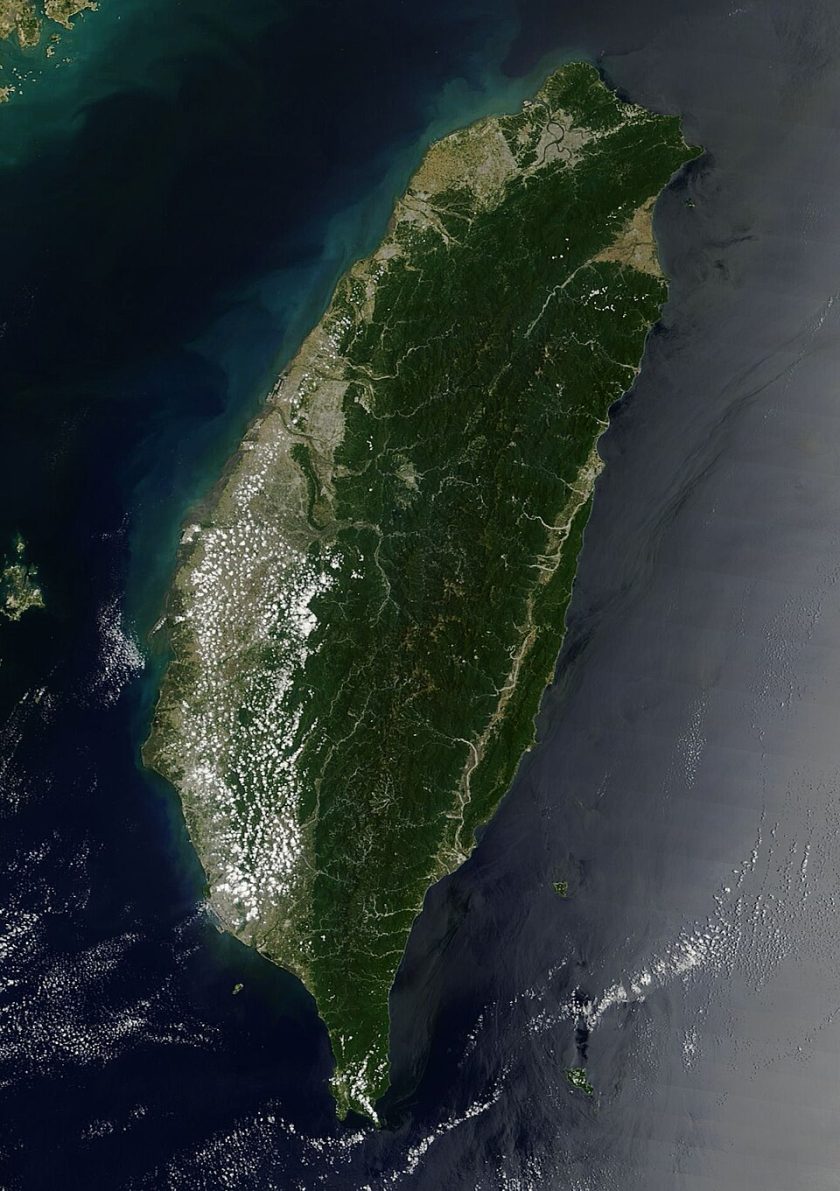
First Shots in Orbit? Space Warfare and the Taiwan Contingency
A future Taiwan contingency may begin far above the island itself. As the United States and China expand counter-space capabilities, satellites supporting communications, navigation, targeting and intelligence are becoming increasingly central to deterrence, escalation and military resilience.
SAGE Strategic Intelligence Brief #008
First Shots in Orbit? Space Warfare and the Taiwan Contingency
01 September 2026
SAGE International Australia
Author: Dr John Bruni
Suggested Citation
Bruni, John. “First Shots in Orbit? Space Warfare and the Taiwan Contingency.” Strategic Intelligence Brief No. 008. SAGE International, September 2026, Adelaide, Australia
Executive Summary
Space has become indispensable to modern military operations. Satellite systems allow military forces to communicate across enormous distances, locate and track adversary forces, navigate precisely, detect missile launches and coordinate complex operations across multiple domains.
Nowhere would these capabilities matter more than in an Indo-Pacific conflict.
The distances between Australia, Guam, Japan, the South China Sea, and Taiwan mean American and allied forces would depend heavily on space-based communications, intelligence, and navigation to operate effectively.
China understands this dependence.
The People’s Liberation Army has therefore invested heavily not only in its own military space capabilities, but also in systems designed to interfere with an adversary’s.
Recent reporting has highlighted accelerating American and Chinese experimentation with manoeuvrable satellites, reusable spaceplanes, electronic warfare and other technologies with potential counter-space applications. Reuters reported in early September that both countries are increasingly preparing for military competition in orbit, including satellites that can approach or operate near other spacecraft.
U.S. Space Command has separately warned that China is developing ground- and space-based systems capable of threatening satellites across multiple orbital regimes and is increasingly exploring on-orbit refuelling, manoeuvre and logistics.
The emerging competition raises three strategic concerns.
First, attacks on satellites could undermine the ability of U.S. and allied forces to conduct long-range operations in defence of Taiwan.
Second, the distinction between peaceful and military activity in orbit is becoming increasingly difficult to determine because many technologies — including satellite servicing, inspection and refuelling — have legitimate civilian uses but can also support military operations.
Third, space warfare generates potentially dangerous escalation incentives. A satellite that is indispensable during conflict may become more attractive to attack during the opening phase of a crisis.
The strategic contest over Taiwan may therefore begin well above the island itself.
Key Judgement
A future conflict over Taiwan is increasingly likely to extend into space at, or potentially before, the opening of conventional hostilities.
Both the United States and China depend heavily on satellites for intelligence, surveillance and reconnaissance; communications; navigation and timing; missile warning; targeting; and command and control. China is simultaneously developing a widening range of counter-space capabilities, including electronic warfare, ground-based anti-satellite systems and manoeuvrable spacecraft capable of operating in close proximity to other satellites. The United States is responding by developing more resilient constellations, counter-space capabilities and increasingly integrated allied space operations.
The strategic danger is not simply that satellites could be attacked.
It is that vulnerable space systems may create incentives to act early in a crisis. If either side believes key orbital capabilities could be lost once conflict begins, it may see an advantage in disrupting the opponent’s systems before they can be fully employed.
A Taiwan contingency could therefore develop simultaneously across the maritime, air, cyber, electromagnetic and space domains rather than progressing neatly from political crisis to conventional combat.
For Australia, assured access to resilient space-based services is increasingly a prerequisite for effective military operations and national resilience. Space should consequently be regarded not as a supporting technical domain, but as part of the fundamental infrastructure upon which Australian deterrence depends.
Space Is No Longer a Sanctuary
For much of the post-Cold War period, the United States enjoyed overwhelming military advantages, partly derived from its command of space-based systems.
Modern American military power increasingly depends on satellites.
They provide:
- intelligence, surveillance and reconnaissance;
- secure communications;
- positioning, navigation and timing;
- missile warning;
- targeting information;
- weather and environmental data;
- and command-and-control support.
These capabilities allow geographically dispersed forces to operate as an integrated system.
But dependence creates vulnerability.
China’s military modernisation has increasingly focused on disrupting the information architecture that enables American forces to fight effectively.
U.S. Space Command assesses that the People’s Liberation Army views counter-space capabilities as a means of degrading the United States’ ability to project military power. Previous U.S. assessments have identified Chinese anti-satellite missiles, electronic jamming, directed-energy research and manoeuvrable satellites among the capabilities potentially available to Beijing.
The objective need not necessarily be the physical destruction of satellites.
A satellite can also be:
- jammed;
- spoofed;
- temporarily blinded;
- cyber-compromised;
- forced to manoeuvre;
- or otherwise denied to its operator.
This distinction matters.
Kinetic destruction produces debris and unmistakable evidence of attack.
Non-kinetic interference may offer greater ambiguity and potentially greater control over escalation.
The emerging contest in space may therefore resemble other forms of contemporary grey-zone competition: states testing how much disruption they can impose without triggering an uncontrolled military response.
China’s Expanding Counter-Space Toolkit
China has developed one of the world’s most sophisticated military space programs.
The PLA increasingly relies upon its own satellites to detect and track forces throughout the Western Pacific. U.S. military assessments have identified hundreds of Chinese intelligence, surveillance and reconnaissance satellites supporting targeting and operational awareness.
This creates an important change in the military balance.
China is no longer simply attempting to deny American forces access to space.
It is also building an increasingly sophisticated, space-enabled military system.
The competition therefore works in both directions.
American and allied forces depend upon satellites to operate.
So does the PLA.
Recent Chinese activity has drawn particular attention to manoeuvrable spacecraft.
Reusable spaceplanes and satellites capable of rendezvous and proximity operations can perform legitimate functions such as inspection, servicing, refuelling and debris removal.
But the same ability to approach another spacecraft creates obvious military possibilities.
A satellite capable of manoeuvring alongside another satellite may also potentially monitor it, interfere with it or physically disable it.
U.S. Space Command has highlighted Chinese experimentation involving the Shijian series of satellites and possible on-orbit servicing and refuelling. General Stephen Whiting warned in January that refuelable spacecraft could acquire significant manoeuvrability advantages over older satellites possessing only limited fuel reserves.
This introduces a new dimension to military competition.
Traditionally, satellites followed comparatively predictable orbital paths.
Increasing manoeuvrability means that spacecraft may begin behaving more like platforms in other military domains.
They can reposition.
They can approach.
They can evade.
And potentially contest one another.
Why Taiwan Changes the Equation
A Taiwan contingency would place extraordinary demands upon U.S. and allied space systems.
The Western Pacific is geographically enormous.
American forces responding to a major conflict could operate from Japan, Guam, Australia, Hawaii and continental United States locations, while naval forces moved through a vast maritime theatre.
Coordinating those forces would depend heavily upon space.
Chinese military planners therefore face a logical operational problem.
If the PLA attempts to isolate or invade Taiwan, U.S. space-based intelligence and communications could help American and allied forces identify Chinese movements, track ships and aircraft, coordinate long-range strikes and defend regional bases.
Disrupting that network could significantly complicate intervention.
China’s own military doctrine has long emphasised the importance of information dominance and degrading an opponent’s command-and-control architecture. This raises the possibility that counter-space operations could occur very early in a conflict. They might even precede large-scale conventional attacks.
A Taiwan crisis could consequently unfold through a sequence such as:
- political confrontation;
- cyber and electronic interference;
- satellite jamming or disruption;
- attacks on command-and-control networks;
- missile strikes against regional bases;
- and large-scale maritime and air operations.
These stages need not occur independently.
They could develop almost simultaneously.
The First-Move Problem
The most dangerous characteristic of space warfare may be its potential to encourage early action.
Military strategists sometimes refer to a use-it-or-lose-it problem.
If a capability becomes highly vulnerable once conflict begins, decision-makers may feel pressure to employ it before it is destroyed.
Space systems can create a related dynamic.
Suppose both sides believe that certain satellites provide enormous wartime advantages but are also vulnerable to attack. Each may then face an incentive to interfere with the other’s systems before its own are degraded. That produces instability.
A manoeuvrable satellite approaching another spacecraft may be conducting inspection.
Or positioning itself for attack.
Electronic interference may be temporary harassment. Or preparation for wider military action. The difficulty lies in determining intent quickly enough to respond.
Space also complicates signalling.
Destroying an aircraft or ship is unmistakably military. Interfering with a satellite may be more ambiguous. This ambiguity could provide escalation control.
It could also produce miscalculation.
From Exquisite Satellites to Resilient Networks
The United States and its allies are already adapting.
One emerging approach is to reduce dependence upon small numbers of extremely expensive, highly capable satellites and move towards larger distributed constellations.
The strategic logic is straightforward.
Destroying or disabling one large satellite may produce a major capability loss.
Disabling a small number of satellites within a constellation of hundreds produces a much smaller effect.
Resilience can therefore become a form of deterrence.
If attacking satellites does not significantly reduce an opponent’s military capability, the incentive to attack them decreases.
Commercial space systems are also changing the equation.
The war in Ukraine has demonstrated the military significance of commercially operated satellite communications and imagery.
Future conflict may therefore involve complex networks combining:
- government satellites;
- commercial constellations;
- allied systems;
- airborne communications;
- terrestrial networks;
- and alternative navigation technologies.
This makes military space architecture more resilient. It also blurs the distinction between civilian and military infrastructure.
Commercial satellites supporting military operations could become targets.
Civilian services could consequently be disrupted even when attacks are intended primarily to produce military effects.
Australia Is Already Part of the Space Contest
Australia cannot regard this competition as geographically distant.
The Australian Defence Force is increasingly dependent upon space for communications, intelligence, surveillance, reconnaissance, targeting, positioning, navigation and timing.
Defence itself describes assured access to space-enabled capabilities as fundamental to modern military operations.
The 2026 National Defence Strategy and Integrated Investment Program explicitly place greater emphasis on secure and resilient multi-orbit satellite communications, space situational awareness and integration across the five operational domains.
Australia has also deepened military space cooperation with the United States.
In June, Australian and U.S. military leaders signed a Statement of Intent to expand cooperation in military space operations, explicitly recognising space capabilities as foundational to modern conflict.
Australia is simultaneously contributing to multinational space-security arrangements through the Combined Space Operations Initiative and Operation Olympic Defender.
Recent investments in space-domain awareness are also noteworthy.
Defence is testing Australian-developed surveillance technologies including the SkyDome passive radio-frequency system in South Australia and UNSW Canberra’s Viper optical telescope.
These developments are strategically important.
Australia’s geography makes it valuable for observing parts of the sky difficult to monitor from the Northern Hemisphere.
That creates opportunities for sovereign capability.
It also means Australian facilities could become important components of allied military space architecture during a crisis.
The National Resilience Dimension
The consequences of space warfare would not remain confined to armed forces.
Modern societies depend heavily upon satellites.
Civil aviation uses satellite navigation.
Shipping relies on positioning and communications.
Agriculture uses precision-navigation systems.
Financial networks depend upon accurate timing.
Emergency services use satellite communications.
Telecommunications networks require timing synchronisation.
Weather forecasting relies upon orbital systems.
A sufficiently serious disruption to space-based services could therefore affect civilian society as well as military operations.
This transforms space security into a national-resilience issue.
Australia’s defence planning increasingly recognises national resilience as part of national defence. The 2026 National Defence Strategy explicitly calls for stronger civil preparedness and resilience against regional or global disruption.
Space resilience should be incorporated into that discussion.
Governments need to understand which essential services depend upon satellite systems and what alternatives exist if those services become degraded.
Redundancy matters.
Terrestrial backups matter.
Alternative navigation systems matter.
Protected communications matter.
Rapid replacement capacity matters.
And the ability to identify hostile behaviour in orbit matters.
Assessment
The emergence of counter-space warfare does not mean a future U.S.–China conflict will inevitably begin with satellites being physically destroyed. Indeed, kinetic anti-satellite attacks may remain unattractive because they generate debris, affect third parties and can produce unpredictable escalation.
More likely early options may involve reversible or partially reversible effects:
- electronic jamming;
- cyber intrusion;
- temporary sensor dazzling;
- navigation interference;
- proximity operations;
- and attacks against terrestrial components of satellite networks.
But the larger trajectory is clear.
Space is becoming contested in the same way that the sea, air, land and cyber domains are contested. The strategic significance is profound. Military forces increasingly depend upon highly interconnected information networks. Attacking those networks may produce greater operational effects than attacking individual platforms.
A future Taiwan conflict could therefore become a contest over who can preserve its military nervous system while disrupting the adversary’s.
The satellites above the battlefield may consequently become as important as the ships and aircraft operating below them.
Implications for Australia
Australia should draw five preliminary conclusions.
First, resilient access to satellite communications, navigation and intelligence must be treated as essential warfighting infrastructure rather than enabling support.
Second, space-domain awareness should remain a priority. Australia cannot protect or respond to threats it cannot identify and attribute.
Third, Australia should continue moving towards distributed, multi-orbit and allied space architectures rather than dependence upon a small number of high-value systems.
Fourth, national-resilience planning should assess civilian dependence upon satellite-based navigation, timing and communications and identify workable alternatives during prolonged disruption.
Fifth, Australia should continue developing sovereign space expertise and industrial capability while remaining deeply integrated with allied networks.
The strategic objective is not Australian independence from allied space systems.
That would be unrealistic and unnecessary.
It is ensuring that Australia remains a capable and resilient contributor to an allied system that cannot easily be blinded or paralysed.
SAGE Bottom Line
The militarisation of space is no longer hypothetical. The United States and China are already developing capabilities intended to protect, manoeuvre, disrupt and potentially attack systems in orbit.
A future crisis over Taiwan would place these capabilities under unprecedented pressure. Space warfare would not necessarily begin with spectacular satellite explosions.
It could begin quietly:
- a navigation signal becomes unreliable;
- a communications satellite stops responding;
- a sensor is temporarily blinded;
- a spacecraft begins manoeuvring unexpectedly;
- a ground station experiences a cyberattack.
Only later might it become clear that a conflict had already begun. This possibility demands a broader understanding of deterrence and how deterrence works in the space domain. Modern military power does not depend solely upon aircraft, ships and missiles.
It depends upon the information architecture that connects them.
Protecting that architecture — in orbit and on Earth — is becoming one of the central requirements of credible defence preparedness.
The first battle over Taiwan may therefore not take place in the Taiwan Strait.
It may take place hundreds or thousands of kilometres above it.
Disclaimer
SAGE Strategic Intelligence Briefs are produced independently and are intended to support informed discussion of geopolitical, defence, security and economic developments. Assessments reflect information available at the time of publication and may change as new information emerges.
About SAGE International Australia
SAGE International Australia is an independent strategic research and analysis organisation specialising in geopolitics, defence, national security, economic resilience and strategic foresight.
Through objective, evidence-based and non-partisan analysis, SAGE helps decision-makers understand risk, identify opportunity and prepare for future challenges.
For more information, visit: