
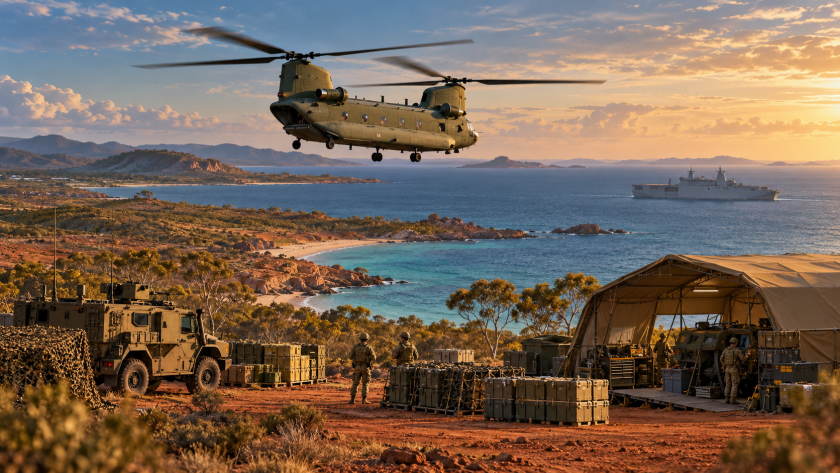
From Fire Force to Sovereign Defence: An Australian Doctrine for Mobility, Sustainment and Resistance to Coercion
From Fire Force to sovereign mobile defence: adapting historical lessons in mobility and integration to Australia’s contemporary defence needs.
SAGE Strategic Intelligence Brief #012
From Fire Force to Sovereign Defence: An Australian doctrine for mobility, sustainment and resistance to coercion
12 October 2026
SAGE International Australia
Author: Dr John Bruni
Suggested Citation
Bruni, J. (2026). From Fire Force to Sovereign Defence: An Australian Doctrine for Mobility, Sustainment and Resistance to Coercion. SAGE Strategic Intelligence Brief No. 012. SAGE International Australia, 12 October 2026, Adelaide, South Australia
Key judgement
Australia should adopt a conventional joint doctrine of sovereign mobile defence: an Australian-directed system that rapidly brings together existing land, maritime, and air capabilities, sustains them through disruption, and preserves national freedom of action under prolonged coercion. Selected principles from Rhodesian Fire Force—habitual integration, responsive command, mobility and economy of force—offer a useful historical starting point. They do not provide a complete doctrine for defending a maritime continent against a major power.
The proposal is to change how the Australian Defence Force prepares, combines and sustains its existing capabilities. It does not depend on creating another service, purchasing a new fleet, or increasing the announced defence funding envelope. Its affordability nevertheless requires proof: more readiness, maintenance and operational activity carry real costs even when the equipment is already owned.
The historical lesson—and its boundary
The Rhodesian Fire Force integrated intelligence, infantry, helicopters, and supporting aircraft to rapidly bring limited resources to an engagement. Habitual cooperation and well-understood procedures let small forces act with coordination disproportionate to their size. Its light ground elements, however, depended heavily on external support and frequent replenishment. Mobility did not eliminate their logistical burden; it simply shifted much of it elsewhere.[1]
This was a counterinsurgency method serving a white-minority state, not a tested model for defeating a modern peer military. Tactical effectiveness neither legitimised that political order nor secured its strategic survival. Australia should study the method with the same critical distance applied to any historical military organisation.
The transferable lesson is organisational: build coherent teams around resources that can actually be generated and sustained. The elements to reject matter just as much. Australia cannot assume permissive airspace, lightly equipped opponents, short operational distances or the safety of conspicuous airborne command arrangements. Modern surveillance, electronic warfare, air defence and precision attack make those assumptions untenable against a capable state adversary.
Integration, mobility and mission command are not uniquely Rhodesian inventions. The value of this comparison lies in sharpening Australia’s implementation of familiar principles under severe resource constraints. The proposal must improve on current ADF practice, not rebrand existing joint operations.
A national conventional doctrine
Sovereign mobile defence would establish the organising principles for Australia’s conventional military employment across competition, crisis and war. Its purpose would be to preserve Australia’s ability to protect its territory, sustain essential military functions and contribute to regional security despite interference or delayed allied assistance.
Five foundations would govern subordinate service doctrine and training:
- Australian priorities and decision authority. National missions, preparedness requirements and sustainment limits determine the forces Australia commits.
- Habitual joint integration. Assigned elements train together before a crisis, with common procedures and clear command relationships.
- Mobility with protection. Movement is selected based on threat, distance, infrastructure, and available protection. Helicopters are one means among several.
- Sustainment before commitment. A deployable force includes the people, supplies, maintenance, medical support and replacement arrangements needed to remain effective.
- Continuity under pressure. Communications disruption, interrupted imports and repeated deployments are normal planning conditions, not exceptional exercise complications.
The doctrine must encompass conventional maritime and air combat, combined-arms land operations, infrastructure defence and mobilisation. A light infantry response force alone cannot do so. Submarines, surface combatants, combat aviation, protected land forces and supporting capabilities retain their distinct roles. The historical analogy informs the way these capabilities cooperate; it does not make them all subordinate to an air-mobile infantry model.
Geographic priorities should start with Australia and its approaches, then move to agreed operations in the Pacific and Southeast Asia. Regional access, local legitimacy and host-government consent are operational requirements. A neighbouring state’s political choices are not automatically an Australian military problem.
Start with the force Australia can actually generate
Implementation should use existing headquarters, service establishments and units. Headquarters Joint Operations Command should sponsor a bounded trial, with the services responsible for generating and sustaining its assigned elements. No additional permanent headquarters is presumed necessary.
The trial should assemble a repeatable joint force package from current units rather than establish a new standing formation. Its size must follow verified availability of personnel, lift, protection and support. The same scarce enabling unit cannot be promised simultaneously to several readiness commitments.
| Existing capability base | Contribution to the proposed doctrine | Binding qualification |
|---|---|---|
| Conventional infantry, protected mobility, engineers, signals, logistics and medical units | Ground presence, protection, mobility and restoration of military functions | Include support personnel, recovery and rotations in the force requirement |
| In-service CH-47F and available UH-60M helicopters | Movement and support where conditions permit | Black Hawk introduction is ongoing; aircraft deliveries are not equivalent to deployable units |
| Existing transport aircraft, including C-17A and C-130J | Movement between operational areas and established support locations | Aircraft, crews, airfields and maintenance compete with other national tasks |
| In-service amphibious ships and landing craft | Maritime movement and support | Availability and protection determine usable capacity; future vessels are excluded from the initial baseline |
| Existing surveillance, command, combat-air and naval capabilities | Awareness, protection and the wider conventional combat framework | These scarce joint assets remain subject to national prioritisation |
| Existing certified weapons and fielded fires capabilities | Support to authorised conventional missions | Count only weapons, trained crews and integrations actually available for the task |
Defence reported Black Hawk and Chinook training together in April 2026, while its Black Hawk training plan anticipates further development through 2029. HIMARS is already being exercised, including movement ashore, but that does not establish the readiness of every planned launcher, regiment or munition.[2–4]
The initial concept therefore requires no future submarine, new landing ship or unfielded weapon to function. Planned capabilities may strengthen it after acceptance and certification. They cannot fill present gaps on paper.
What Australia must sustain for itself
Sovereignty should be measured by the ability to keep priority missions operating during disruption. It does not require manufacturing every component domestically. Australia does require an explicit account of the dependencies that could stop those missions and a funded response to each critical one.
First, Australia must own its readiness picture. Government needs reliable information on serviceability, maintenance backlogs, repair capacity, critical stocks and the personnel needed to generate forces. Commercial arrangements must provide the necessary visibility. Aggregate fleet numbers are an inadequate substitute.
Second, Australia must perform essential maintenance and recovery at home. Priority platforms require assured access to qualified maintainers, workshops, tooling, test equipment, technical documentation and certified repair arrangements. Defence should identify which repairs can be completed locally, which require overseas facilities, and which components must be stocked because a domestic repair line would be uneconomic.
Third, Australia must secure the rights needed to sustain imported equipment. Contracts should seek the technical data, licences, software support and permissions required for agreed domestic work. Local assembly or a maintenance facility does not, by itself, confer independent support capability. Access to proprietary components and foreign-controlled updates remains a separate question.
Fourth, Australia must fund stocks against disruption scenarios. Australia should assess fuel, lubricants, tyres, batteries, medical supplies, repairable assemblies, and munitions against specified missions and delayed replenishment. A universal stockholding target would conceal very different consumption and supply risks. Requirements should instead reflect the time needed to restore a disrupted source or obtain an alternative.
Fifth, Australia must preserve the workforce that makes readiness possible. Uniformed technicians, civilian specialists and industry trades need sustained workloads, training and retention. Contracts should reward usable availability and repair turnaround, with government retaining visibility of safety and quality. Surge clauses are meaningful only if personnel, materials and facilities exist.
Sixth, Australia must sustain the infrastructure behind the platforms. Ports, airfields, communications, electricity, fuel distribution and transport links require repair plans and exercised civil-military arrangements. Overseas access agreements should address practical support and lawful authority before a crisis.
A foundation already exists to build on. Australia’s F-35 support arrangements include domestic and regional maintenance functions within an international support system. Defence also opened a P-8A deep-maintenance and modification facility at Edinburgh in 2026.[5–6] These developments demonstrate domestic capacity, not complete independence from foreign supply chains. The policy task is to identify and reduce the remaining mission-critical dependencies.
Countering Chinese Threshold Conditioning
For this brief, Threshold Conditioning means the cumulative adjustment of a defender’s practical tolerance and behaviour under persistent coercive pressure. Its strategic effect is visible when Australia progressively abandons activities, access or choices it previously intended to preserve.
Applied to China, this is an analytical framework to test against evidence, not an assumption that every Chinese activity is hostile or centrally coordinated. Distinguish lawful navigation, commercial competition, and diplomatic influence from coercion. Assess attribution, intent, and operational effect separately.
The force described here would support counter-conditioning by making Australia’s lawful activities harder to interrupt and cheaper to sustain. Its decisive output would be continuity: restored military functions, sustained agreed commitments, and preserved national choices.
Australia should assess patterns across incidents through existing national-security arrangements. A succession of maritime pressure, infrastructure interference or cyber disruption may impose a cumulative burden even when no single incident warrants military escalation. The assessment should ask what activity has changed, what capacity has been consumed and whether the response is sustainable.
The corresponding response must draw on diplomacy, law enforcement, infrastructure protection, economic policy and Defence as appropriate. Military readiness provides credible support to those instruments; it cannot replace them. Australian forces should operate under lawful authority and political direction, with no automatic escalation based on an incident count.
An illustrative resilience test would combine prolonged maritime tension with disruption to a military support function and delayed overseas replenishment. The question is whether Australia can maintain its approved activities, protect readiness and restore the affected function without exhausting its best forces. This is a planning scenario, not an allegation about a particular incident or a tactical response plan.
The danger is answering every inexpensive provocation with an expensive deployment. A doctrine intended to counter conditioning must control its own consumption of flying hours, maintenance capacity, personnel endurance and political attention. Cost-effective persistence matters more than theatrical responsiveness.
Allied cooperation without doctrinal dependence
Australia should remain able to operate alongside allies through compatible communications, procedures, logistics interfaces and joint training. Interoperability should reinforce the national doctrine by making Australian contributions easier to combine with allied capabilities.
Australia must nevertheless retain authority over commitments and understand which missions it can sustain without immediate allied reinforcement. Assess each priority mission under three conditions: national resources alone, normal allied support, and interrupted allied support. The national baseline must be bounded and credible; it is not a claim that Australia can independently defeat a major power across every domain.
Coalition command arrangements may change for an agreed operation. Australia’s foundations—coherent force packages, protected mobility, sustainable commitments and national decision authority—should remain. Where a coalition task exceeds those foundations, government should explicitly accept the dependence, provide additional support, reduce the task or decline it.
Reform within the forecast funding envelope
The governing fiscal rule should be explicit: the reform must fit within approved annual allocations and the published forward funding profile, including its recurring costs. Future budget growth already committed to other capabilities is not an unallocated reserve.
The 2026–27 Defence Portfolio Budget Statements put departmental planned expenditure at approximately $60.65 billion, including $18.52 billion for capability sustainment. These departmental figures are distinct from broader portfolio totals and the April National Defence Strategy’s funding presentation.[7] Neither measure identifies money freely available for this proposal.
The first stage should therefore redirect a bounded portion of already funded exercise, doctrine-development and readiness activity. Any additional expenditure must have an identified offset, approved through the normal budget process. The trial should not assume that contractor savings, vacant posts or reduced administration will automatically fund operational readiness.
| Priority expenditure | Required funding discipline |
|---|---|
| Joint training and force-package certification | Replace specified existing activities where practicable; cost additional fuel, hours, ammunition and support |
| Technical workforce and critical repair capability | Identify affordable trade-offs and phased contracts; do not treat skilled labour as instantly available |
| Essential spares and consumables | Prioritise demonstrable mission-stopping shortages and account for storage, expiry and replenishment |
| Domestic repair rights and selected industrial capacity | Compare domestic provision with stockholding and diversified supply, including licensing and demand risks |
| Resilient supporting infrastructure | Sequence work within approved estate and capability plans, recording what is deferred |
Budget neutrality is a constraint to demonstrate, not a finding of this brief. No public dataset establishes the full marginal cost of the proposed posture or all internal offsets. A credible business case must include implementation costs, annual operating costs, equipment wear, workforce impacts, and lost readiness elsewhere. Deferrals must not merely push an unaffordable bill beyond the forward estimates.
Where the existing envelope cannot fund the desired scale, the doctrine must narrow simultaneous commitments, geography or readiness ambition. It must not disguise an under-resourced force as efficient.
Implementation and proof
Over the first six months, Defence should define a small number of national missions, map the existing commitments of their enabling forces and establish a serviceability and sustainment baseline. The work should identify what current doctrine already achieves and the specific deficiencies this proposal would address.
Over the following twelve months, one joint package should be trained and evaluated using existing formations and budgeted activity. Exercises should test communications disruption, delayed resupply, repair turnaround and the ability to generate a subsequent rotation. Independent evaluation should challenge assumptions about access, allied availability and personnel endurance.
Expand only if the trial produces measurable gains within its cost ceiling. Measures should include time to generate a complete force, sustained availability, restoration of degraded functions, readiness remaining for another contingency, and total cost relative to the current approach. Deployment speed alone is insufficient.
Fire Force’s historical appeal is the disciplined integration of scarce means. Australia’s requirement is broader: a conventional force that can move, fight, recover and continue operating under persistent pressure. Its credibility will rest on the national support system behind it and the government’s willingness to match commitments to resources. A force that arrives quickly but cannot remain effective offers only a brief interruption to an adversary’s campaign of conditioning.
Sources
- Scandinavian Journal of Military Studies, “Deployment of Light Infantry Under Air Mobility Doctrine – A Historical Study of Helicopter-deployed Light Infantry.”
- Australian Department of Defence, “Black Hawks train over Townsville,” 8 April 2026.
- Australian Department of Defence, “Black Hawk fleet returns to South East Queensland,” 8 July 2025.
- Army News, “HIMARS from ship to shore,” 28 May 2026.
- Australian Department of Defence, “Joint Strike Fighter Aircraft.”
- Australian Department of Defence, “Major milestone for sovereign defence capability,” 22 May 2026.
- Australian Department of Defence, 2026–27 Portfolio Budget Statements, Part 2, Table 4, printed page 21.
Disclaimer
SAGE Strategic Intelligence Briefs are produced independently and are intended to support informed discussion of geopolitical, defence, security and economic developments. Assessments reflect information available at the time of publication and may change as new information emerges.
About SAGE International Australia
SAGE International Australia is an independent strategic research and analysis organisation specialising in geopolitics, defence, national security, economic resilience and strategic foresight.
Through objective, evidence-based, non-partisan analysis, SAGE helps decision-makers understand risk, identify opportunity, and prepare for future challenges.
For more information, visit: