
Threshold Conditioning: War by Miscalculation
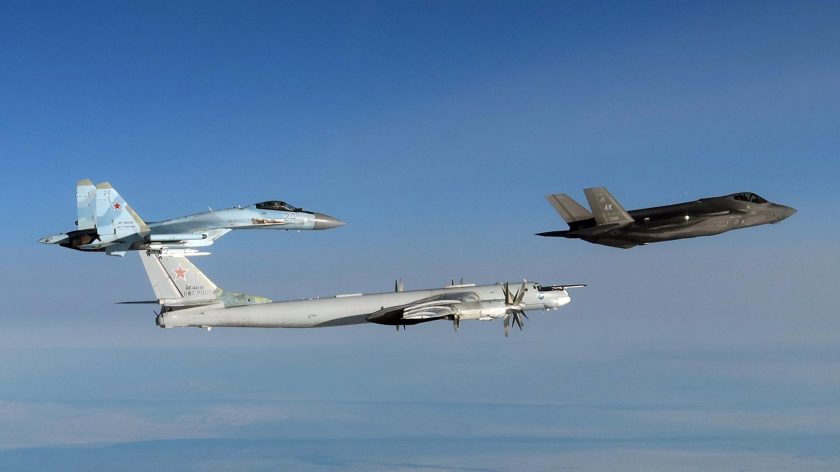
A US F-35 flies in proximity to Russian military aircraft—an illustration of the close encounters that characterise contemporary great-power competition. SAGE's concept of *threshold conditioning* examines how repeated exposure to increasingly coercive behaviour can normalise strategic risk, narrowing the margin between managed competition, miscalculation and escalation.
SAGE Strategic Intelligence Brief #006
Threshold Conditioning: WAR BY MISCALCULATION
World War E and the Emerging US–Iran–China–Russia Contest
27 August 2026
SAGE International Australia
Author: Dr John Bruni
Suggested Citation
Bruni, J. (2026). Threshold Conditioning: War by Miscalculation (SAGE International Strategic Intelligence Brief No. 006). Adelaide: SAGE International Australia.
EXECUTIVE SUMMARY
The intensifying US–Iran confrontation is evolving beyond a conventional sanctions campaign into a broader test of economic power, strategic resilience and great-power tolerance. Washington is seeking to constrict Iran’s remaining financial and commercial lifelines; Tehran is attempting to demonstrate that economic degradation will not produce strategic capitulation; and China continues to provide the economic space necessary to prevent Iran’s complete isolation.
SAGE assesses this contest through the concept of threshold conditioning: the gradual normalisation of increasingly coercive behaviour until actions once considered exceptional become accepted features of strategic competition. Each sanctions package, act of evasion, countermeasure and third-party intervention establishes a new baseline from which further escalation becomes possible.
China represents the critical external variable. Beijing need not rescue Iran economically; it need only provide sufficient access to markets, trade and financial mechanisms to prevent US coercion from becoming decisive. Washington must therefore determine how aggressively it can target Iran’s Chinese economic connections without transforming the confrontation into a direct US–China dispute.
Russia adds further strategic ambiguity. CIA Director John Ratcliffe’s August 2026 visit to Moscow cannot presently be linked directly to Iran. Nevertheless, maintaining high-level US–Russian intelligence contacts shows that Washington is managing several interconnected strategic relationships at once. Any weakening of Russian support for Tehran would further increase Iran’s dependence on China.
The resulting contest resembles hostile aircraft approaching one another, each pilot expecting the other to turn first. The principal danger is therefore not necessarily deliberate escalation, but cumulative miscalculation.
Within SAGE’s World War E framework, the confrontation currently occupies the E2–E4 spectrum: economic resilience, economic protection and economic retaliation. The critical risk is movement towards E5—economic confrontation producing kinetic consequences.
The central question is no longer simply whether economic coercion can hurt Iran. It is whether that pressure can change Iranian behaviour without normalising increasingly dangerous forms of escalation among the United States, Iran, China and Russia.
THRESHOLD CONDITIONING
Threshold conditioning occurs when repeated exposure to progressively more serious coercive behaviour alters perceptions of what constitutes unacceptable escalation.
The sequence is:
Action → Adaptation → Normalisation → Escalation → Further Adaptation
In economic warfare, this process is particularly dangerous because there is no universally recognised equivalent of a military red line.
Targeted sanctions can become sectoral sanctions.
Sectoral sanctions can expand into shipping restrictions.
Shipping restrictions can become secondary sanctions against third parties.
Financial exclusion can lead to asset seizures, counter-sanctions, cyber retaliation and maritime confrontation.
At every stage, yesterday’s escalation risks becoming tomorrow’s baseline.
KEY JUDGEMENT
The intensifying US–Iran confrontation is evolving beyond a conventional sanctions campaign. Washington’s economic pressure is increasingly testing not only Iran’s capacity to endure, but also China’s willingness to protect Tehran and Russia’s willingness to remain strategically aligned with it.
This represents a form of threshold conditioning: progressively coercive actions become normalised until behaviour once considered escalatory becomes routine.
The immediate danger is not necessarily deliberate war. It is miscalculation produced by repeated testing of thresholds, particularly if each actor concludes that its opponents will ultimately yield first.
THE ‘ECONOMIC AIRCRAFT’
The strategic dynamic resembles hostile aircraft approaching one another head-on.
Neither pilot necessarily wants a collision.
Neither wants to turn first.
Each therefore assumes that the other has the lower tolerance for risk.
Washington may believe Iran’s economic pain will eventually force Tehran to compromise.
Tehran may believe Washington lacks the political appetite for another prolonged confrontation.
Beijing may believe the United States will not risk a major economic confrontation with China merely to eliminate Iran’s remaining financial lifelines.
Moscow may calculate that it can retain relations with Iran while simultaneously maintaining channels with Washington.
Each assumption may be rational in isolation.
Collectively, they create the conditions for miscalculation.
CHINA: THE CRITICAL THRESHOLD
China is Iran’s most important economic escape valve.
Beijing does not need to rescue the Iranian economy. It needs only to prevent its complete isolation by maintaining sufficient access to energy markets, industrial goods, transportation, financial mechanisms and diplomatic space.
Washington therefore confronts a difficult calculation:
How much pressure can it apply through China’s economic networks before Beijing decides that the confrontation is no longer primarily about Iran, but about China itself?
Beijing faces the inverse problem:
How far can it protect Iran without converting the dispute into direct US–China economic confrontation?
Both powers are approaching the same threshold from opposite directions.
RUSSIA: THE UNCERTAIN VARIABLE
Ratcliffe’s Moscow visit adds strategic ambiguity.
There is insufficient evidence to conclude that Iran formed part of the discussions. Nevertheless, intelligence-to-intelligence contact provides Washington and Moscow with a channel through which intentions, escalation risks, Ukraine, Iran, strategic red lines and possible off-ramps could be discussed.
This raises an important analytical hypothesis:
Washington may benefit from preventing Russia, China and Iran from behaving as a consolidated strategic bloc.
Even partial Russian neutrality would complicate Tehran’s strategic calculations and leave China carrying more of the burden of sustaining Iran’s economic resilience.
This remains a hypothesis—not an established US strategy.
But Iran must account for the possibility.
That uncertainty itself creates pressure.
WORLD WAR E: SANCTIONS AS STRATEGIC SENSORS
Economic coercion does more than impose costs.
It reveals behaviour.
Sanctions identify:
- who complies;
- who circumvents restrictions;
- who provides alternative financial mechanisms;
- who accepts economic pain;
- who retaliates;
- and who quietly seeks accommodation.
Economic warfare therefore produces a form of strategic cartography.
It maps dependencies, relationships and escalation tolerances.
In this sense, sanctions can function as strategic sensors.
Washington is not merely discovering how much economic pressure Iran can absorb.
It is also discovering how much pressure China and Russia are prepared to absorb on Iran’s behalf.
ESCALATION LADDER
SAGE’s World War E framework can conceptualise the confrontation through five levels:
E1 — Economic Coercion
Sanctions, tariffs, export controls and financial restrictions.
E2 — Economic Resilience
Sanctions evasion, alternative currencies, shadow shipping and parallel financial networks.
E3 — Economic Protection
Third powers insulating a targeted economy from complete isolation.
E4 — Economic Retaliation
Counter-sanctions, resource weaponisation, cyber operations and pressure against economic interests.
E5 — Kinetic Consequences
Economic confrontation produces direct military consequences.
The present confrontation sits primarily within E2–E4.
The principal strategic danger is movement from E4 to E5.
Threshold conditioning increases that risk because every coercive action that occurs without decisive retaliation becomes easier to repeat—and potentially easier to exceed.
ASSESSMENT
The global economic system is increasingly functioning as a battlespace.
US sanctions seek to restrict Iran’s oil revenues, financial networks, weapons procurement and sanctions-evasion mechanisms. Iran, however, continues to demonstrate economic and strategic resilience, assisted particularly by access to Chinese markets and alternative trading networks.
This creates a triangular contest:
United States — economic coercion
China — economic insulation
Iran/IRGC — resilience and asymmetric retaliation
Russia introduces a fourth variable.
CIA Director John Ratcliffe’s unusual August visit to Moscow cannot presently be linked directly to Iran. Its purpose remains undisclosed. Nevertheless, its timing demonstrates that Washington and Moscow continue to maintain high-level intelligence channels while the United States simultaneously manages Ukraine, Iran and its wider competition with China.
The emerging strategic question is therefore larger than whether sanctions can damage Iran.
It is:
Can Washington progressively isolate Iran without triggering direct confrontation with China or Russia?
INDICATORS TO WATCH
SAGE assesses that the following developments would indicate movement towards a more dangerous phase:
1. Chinese financial institutions targeted
Broad US sanctions against major Chinese banks would suggest a significant expansion of the confrontation.
2. Russian material support increases
Expanded Russian military, technological or sanctions-evasion assistance to Iran would weaken prospects for strategic separation.
3. Iranian economic retaliation expands
Attacks on shipping, energy infrastructure or regional economic interests would indicate movement towards E5.
4. US–Russian intelligence contacts intensify
Further senior-level contacts may indicate active management of escalation thresholds, even where their precise substance remains unknown.
5. Hormuz becomes an enforcement arena
Interdiction, seizure or military protection of sanctioned energy flows would significantly narrow the distinction between economic and kinetic warfare.
SAGE ASSESSMENT
Iranian economic degradation: HIGHLY LIKELY
Iranian strategic capitulation: UNLIKELY IN THE NEAR TERM
Continued Chinese economic support: HIGHLY LIKELY
Direct US–China confrontation over Iran: UNLIKELY, BUT RISK INCREASING
Russian strategic decoupling from Iran: POSSIBLE, NOT ESTABLISHED
Further threshold conditioning: HIGHLY LIKELY
Risk of E4 → E5 transition: ELEVATED
BOTTOM LINE
The central issue is no longer simply whether US sanctions can hurt Iran.
They can.
The more consequential question is whether economic pressure can alter Iranian behaviour without producing an escalating confrontation with the external powers that enable Tehran to endure.
The United States is testing Iran’s tolerance for economic coercion.
China is testing Washington’s willingness to enforce economic exclusion against a major power.
Russia is maintaining relationships on both sides of the emerging divide.
Iran is testing whether it can endure long enough for Washington’s coercive strategy to lose political momentum.
Each actor is therefore asking essentially the same question:
Who blinks first?
The danger is that repeated confrontations teach every participant that its opponents will tolerate just a little more.
That is threshold conditioning.
And the strategic risk is not that any actor deliberately chooses collision.
It is that the aircraft eventually become too close to turn.
Disclaimer
SAGE Strategic Intelligence Briefs are produced independently and are intended to support informed discussion of geopolitical, defence, security and economic developments. Assessments reflect information available at the time of publication and may change as new information emerges.
About SAGE International Australia
SAGE International Australia is an independent strategic research and analysis organisation specialising in geopolitics, defence, national security, economic resilience and strategic foresight.
Through objective, evidence-based and non-partisan analysis, SAGE helps decision-makers understand risk, identify opportunity and prepare for future challenges.
For more information, visit: