
AUKUS: The Trinational Tempest
Introducing The Tyrrell Perspective — a new SAGE International series featuring the strategic observations of Commodore Patrick Tyrrell OBE RN (Ret.).
In his inaugural contribution, “AUKUS: The Trinational Tempest,” Tyrrell draws on decades of naval and strategic experience to examine the political, industrial and military pressures confronting one of the most ambitious defence partnerships of the century — and asks whether AUKUS can weather the storm.
THE TYRRELL PERSPECTIVE
Strategy, intelligence and the view from Britain
Commodore Patrick Tyrrell OBE RN (Ret.)
SAGE International Associate
The AUKUS submarine programme spans decades. Politics operates on much shorter horizons. Patrick Tyrrell examines the strengths, weaknesses, opportunities and threats facing one of the most ambitious defence partnerships of the century.
23 August 2026
I am writing this from my home near Falmouth in Cornwall, in the far South-West of the UK. Falmouth boasts one of the largest natural harbours in the world, guarded by two historic Tudor forts built by King Henry VIII for defence against the marauding French. The area around modern-day Falmouth has been associated with seaborne trade since antiquity, with a long tradition linking Cornwall’s ancient tin trade to Phoenician merchants. The problem is that Falmouth is some 300 miles from London and, although the transport links are better than they were five hundred years ago, they are still not great!
What few people know is that in 1963 Falmouth was among the locations considered as a base for Britain’s new Polaris nuclear-submarine force. Its proximity to deep water made it an obvious candidate, but the Admiralty ultimately selected Faslane on Scotland’s Gare Loch. More than six decades later, the episode remains a useful reminder that submarine programmes are shaped not only by strategic requirements, but by geography, infrastructure, cost and politics.
Fast forward 63 years and we are looking today at another country developing a nuclear-submarine capability amid similarly powerful political winds of change.
The Australian nuclear-submarine programme is being delivered under the AUKUS umbrella, with an initial capability provided by US Virginia-class SSNs and the follow-on capability being the new SSN-AUKUS, built in collaboration with the UK.
The programme is already underway, with Australian personnel being trained in US and UK boats to develop the skills necessary to manage such a complex undertaking.
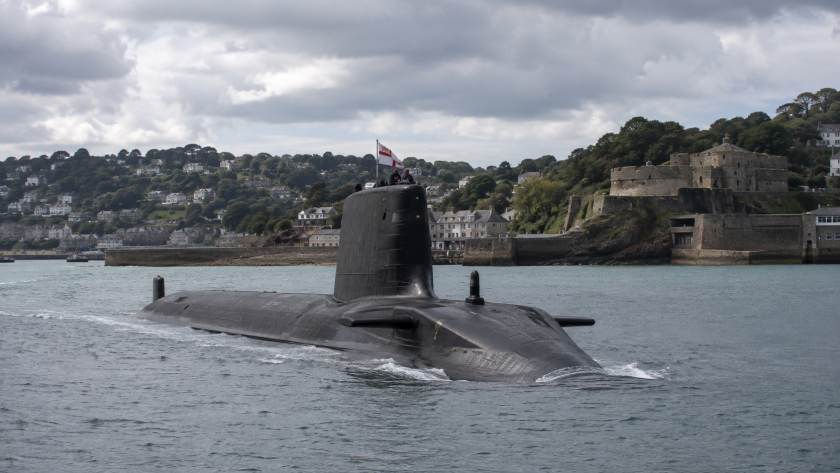
From as early as 2027, Submarine Rotational Force-West is expected to bring a rotational presence of up to four US Virginia-class submarines and one UK Astute-class submarine to HMAS Stirling in Western Australia. Work has already commenced on building the necessary infrastructure to support US, UK and Australian SSNs based in or operating from Australia and for deployment across the Pacific.
Inevitably, the AUKUS project is a long-term arrangement, with delivery of boats extending well into the 2040s and beyond.
It requires considerable commitment on the part of all participating nations, expenditure of vast resources and intensive use of their respective industrial capabilities. Unfortunately, as is the case with most long-term projects, political timescales are rarely aligned with those of the project. Added to this, we are living in a world where strategic timescales also appear to be decreasing, and “strategic churn” is making political and military decision-making more complex and unpredictable.
The principal partner in AUKUS is the United States of America, currently led by an administration that has torn up much of the previous rule book on diplomatic mores and the world trading system that has existed since 1945.
When coupled particularly with the current conflicts in Ukraine and Iran, the development of innovative methods of fighting wars, the logistical difficulties of replacing munitions on the battlefield and the increasing power and spectacular effects of AI, this means that politicians and defence chiefs will always struggle to keep pace with the tempo of the real world. As a Cold War warrior, I can appreciate the slower and more predictable world in which we operated!
It may be a surprise to realise that the past several decades have produced an extraordinary expansion of global wealth and living standards, particularly across Asia, even though those gains have been uneven. One consequence of this increasing prosperity and globalisation was that the older industrial nations exported much of their heavy engineering to developing parts of the world. So, we have steel increasingly produced in Asia, cars in China, ships built in China, South Korea and Japan, and a general hollowing out of industrial capability, especially in Europe and North America. The Chinese have recently unveiled their new airliner designed to compete with Airbus and Boeing in the future.
Nations are now beginning to recognise that this globalisation is not all positive.
China controls a large proportion of the production and, particularly, processing of rare-earth elements increasingly needed for modern technologies. US technology companies retain extraordinary influence over much of the digital infrastructure, cloud computing, software and platform economy on which the global internet depends. Taiwan remains overwhelmingly important to the manufacture of the most advanced semiconductors, including chips central to AI and high-performance computing.
In looking at the AUKUS programme in the light of the enormous flux that we are seeing today, it is worth conducting a simple SWOT analysis to try to identify winners and losers and what each of the parties might hope to gain.
Strengths: The continued rise of China as a great power invariably means that the Pacific Ocean will become an arena where the US and its allies flex their muscles against a rising China. China’s activities, particularly around the strategic choke points associated with the first and second island chains, could become a focus of military action. Having Australian SSNs will complement those of the US in maintaining a coherent submarine capability to protect allies and maritime trade. It will permit Australia to project power beyond its local waters and play a fuller role in supporting the US. The project will foster closer relations between the three navies and provide greater operational depth and resilience.
Weaknesses: Nuclear programmes are not cheap: the programme demands a large proportion of Australia’s defence budget. It also entails both the US and UK expanding submarine construction to support the programme. Both countries face serious submarine-industrial-base constraints, including workforce, supplier and shipyard-capacity pressures, while simultaneously attempting to meet their own fleet requirements and expand production for AUKUS.
Opportunities: AUKUS will allow the US and its key allies to provide a more effective submarine presence in the Pacific and, in particular, in the Southern Ocean. It will also provide greater resilience for submarine operations, with more SSNs available for deployment. By integrating USN, RAN and RN submarine operations, worldwide deployments will be greatly enhanced, and tri-nation research and development will allow them to develop new submarine technologies.
Threats: The greatest threat is that of politics: the programme depends upon long-term funding and consistent political commitment. For such a complex and expensive programme, these would be difficult to maintain under the best of circumstances. The current political flux makes it far more difficult. Building and operating the nuclear infrastructure necessary to support a fleet of operational SSNs is neither cheap nor simple. The support of voters is essential in such a programme and, while the main electorate affected will be Australia, it is important that voters in the US and the UK understand and support the overall objectives of the programme.
In conclusion, the AUKUS programme is facing some severe headwinds and stormy seas. It is all too conceivable that one or other of the participants could eventually bail out. As an integrated programme, AUKUS must be seen to provide value-added defence. The ability of the RAN to provide immediate support to its allies, especially the US, will give Australia much greater heft in the corridors of power. The USN and the RN have a long history of operating these sophisticated platforms in a wide variety of scenarios; the opportunity to share this wealth of knowledge is too good to lose.