
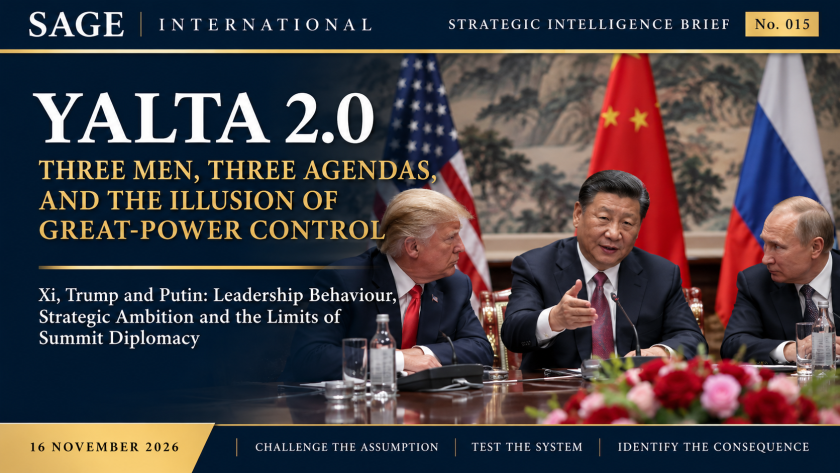
YALTA 2.0 | Three Men, Three Agendas, and the Illusion of Great-Power Control
Yalta 2.0: Xi Jinping, Donald Trump and Vladimir Putin symbolise three competing visions of global power. Eight decades after Yalta, the prospect of renewed great-power summit diplomacy raises a familiar question: who controls the negotiations, and who ultimately shapes the international order?
AI-generated conceptual illustration | SAGE International, 2026.
STRATEGIC INTELLIGENCE BRIEF #015
YALTA 2.0:
THREE MEN, THREE AGENDAS, AND THE ILLUSION OF GREAT-POWER CONTROL
Xi, Trump and Putin: Leadership Behaviour, Strategic Ambition and the Limits of Summit Diplomacy
16 November 2026 | Pre-Summit Intelligence Assessment
16 November 2026
SAGE International Australia
Author: Dr John Bruni
Suggested Citation
Bruni, J. (2026). Yalta 2.0: Three men, three agendas, and the illusion of great-power control. SAGE Strategic Intelligence Brief No. 015, 16 November 2026. SAGE International Australia.
EXECUTIVE ASSESSMENT
At Yalta in February 1945, three leaders gathered to negotiate the foundations of the postwar international order. Franklin D. Roosevelt, Winston Churchill and Joseph Stalin represented an alliance approaching victory, but each approached the negotiations with different political ambitions, security requirements and assumptions about the future.
Eight decades later, the prospect of a meeting between Chinese President Xi Jinping, US President Donald Trump and Russian President Vladimir Putin, on the margins of the Asia-Pacific Economic Cooperation (APEC) summit in Shenzhen, has revived comparisons with that historic gathering.
The symbolism is compelling.
Three leaders representing nuclear-armed powers, three competing visions of international order and three distinct understandings of national greatness.
Yet the comparison requires caution.
Yalta was a negotiation among wartime allies whose military victory in Europe was approaching. The proposed Shenzhen meeting would bring together strategic competitors without a common victory, an agreed settlement, or a shared understanding of the international order they seek to establish.
Moreover, the distribution of negotiating leverage is fundamentally different.
At Yalta, Stalin possessed an extraordinary advantage because Soviet armies occupied much of the territory whose political future was under discussion. Roosevelt sought Soviet assistance against Japan and cooperation in creating the postwar United Nations. Churchill sought to preserve Britain’s increasingly precarious status and prevent Soviet domination of Europe.
At Shenzhen, Xi may possess the advantages of diplomatic centrality and control over the host environment. However, China cannot unilaterally determine the future of Ukraine, compel American nuclear concessions or impose a security settlement upon Europe.
Trump seeks a visible diplomatic achievement while confronting significant domestic political constraints. Putin seeks recognition of Russia’s continuing great-power status despite the consequences of the war in Ukraine and growing economic dependence upon China.
Their interests overlap, but their desired outcomes are not necessarily compatible.
As of 16 November, the APEC leaders’ meeting is scheduled for 18–19 November 2026. Although a trilateral encounter has been reported and anticipated, its substantive agenda and format remain subject to negotiation. The analysis that follows therefore assesses the implications of a proposed meeting, not the outcomes of a completed summit. [1][2]
SAGE International assesses with moderate confidence that the central diplomatic challenge is not simply whether these leaders can reach an agreement, but whether each can accommodate the others without compromising the political identity and strategic objectives upon which his authority rests.
The essential distinction is between diplomatic visibility and the capacity to shape enduring geopolitical outcomes.
The leader who dominates the photograph may not be the leader who shapes the future.
YALTA 1.0: POWER BEFORE DIPLOMACY
The Yalta Conference, held in Crimea between 4 and 11 February 1945, occurred when Nazi Germany’s defeat was increasingly certain.
The Red Army had advanced deep into Eastern Europe. Western Allied forces were moving towards Germany from the west. The war against Japan, however, remained unresolved.
The three Allied leaders negotiated from materially unequal positions.
Stalin’s principal advantage was military occupation.
Soviet forces provided Moscow with the practical means to influence political outcomes across much of Eastern Europe. Stalin did not need to secure every desired concession through diplomatic persuasion because Soviet troops had already established important realities on the ground.
Roosevelt understood the military circumstances but sought objectives extending beyond Europe’s immediate settlement.
He wanted Soviet entry into the war against Japan and agreement on the institutional arrangements that would support the proposed United Nations.
The foundations of that organisation had been developed before Yalta, including at Dumbarton Oaks in 1944. The Crimea Conference advanced the process by resolving important questions concerning Security Council voting and the convening of the San Francisco founding conference. [3][4]
Soviet participation against Japan was also negotiated transactionally.
Moscow agreed to enter the Pacific war two to three months after Germany’s defeat, subject to substantial strategic concessions. These included arrangements involving southern Sakhalin, the Kuril Islands, Port Arthur and Soviet interests in Manchuria. [5]
The agreement demonstrated that even among allies confronting common enemies, diplomatic cooperation required the exchange of material advantages.
Churchill’s position was more constrained.
Britain remained a formidable military and diplomatic participant, but its financial exhaustion and growing dependence upon American power limited its ability to determine events independently.
Churchill was particularly concerned about Poland and the possibility that Soviet influence would become permanent across Eastern Europe.
The Yalta agreements nevertheless contained a fundamental contradiction.
The Declaration on Liberated Europe promised democratic processes and governments reflecting the choices of liberated peoples. The agreements concerning Poland also envisaged a broader provisional government and free elections. [6]
These commitments did not formally authorise the wholesale political subjugation of Eastern Europe.
Yet the realities of Soviet military occupation, followed by Moscow’s actions, enabled the establishment of Soviet-dominated political systems across much of the region.
The subsequent Cold War reflected, in part, the incompatibility between the principles formally endorsed at Yalta and the political order imposed through Soviet power.
The historical lesson is therefore more complex than the familiar claim that Roosevelt and Churchill simply surrendered Eastern Europe to Stalin.
Yalta demonstrated that diplomatic commitments cannot be understood independently of the material capacity, political intentions and strategic incentives of the states responsible for implementing them.
It also demonstrated that immediate negotiating success does not guarantee lasting geopolitical supremacy.
Stalin consolidated Soviet influence across Eastern Europe, but the Soviet Union ultimately entered a prolonged competition with a United States that emerged as the leading power of the Western postwar order.
Roosevelt’s institutional vision produced important and enduring structures, although the expectation of sustained cooperation with Moscow proved optimistic.
Churchill failed to prevent Soviet domination of Poland, but his concerns about the division of Europe proved prescient.
Each leader secured partial achievements.
None obtained the international order precisely as he had envisaged it.
LEADERSHIP BEHAVIOUR AT YALTA
Historical outcomes alone do not explain why leaders make particular decisions.
SAGE’s proposed leadership behavioural framework seeks to identify how political identity, perceived threats, status requirements and decision-making preferences interact with material constraints.
This does not imply clinical psychological profiling.
Rather, it examines publicly observable political behaviour and constructs hypotheses about how leaders are likely to respond when their objectives collide.
Stalin: Security through control
Stalin approached international security by emphasising territorial buffers, political influence, and coercive capacity.
The Soviet Union’s immense wartime losses gave Moscow a powerful security rationale for preventing another invasion from the west.
However, Stalin’s preferences extended beyond defensive guarantees to the political control of neighbouring states.
His behaviour demonstrated a preference for enforceable outcomes over assurances dependent upon the goodwill of other governments.
Behavioural interpretation: Stalin’s conception of security was strongly associated with removing uncertainty through political and military control.
Roosevelt: Security through institutional cooperation
Roosevelt sought a postwar system that could reduce the likelihood of another global conflict.
His approach combined recognition of American military and economic power with confidence in diplomatic cooperation and international institutions.
He believed that continued engagement with Stalin could contribute to a stable settlement.
Behavioural interpretation: Roosevelt placed considerable value upon the possibility that negotiated commitments and institutional arrangements could moderate strategic rivalry.
Churchill: Security through balance
Churchill understood the danger of one power dominating continental Europe.
His approach reflected Britain’s longstanding strategic interest in preventing a hostile hegemon from controlling the European balance of power.
However, his diplomatic ambitions increasingly exceeded Britain’s capacity to enforce them independently.
Behavioural interpretation: Churchill sought to preserve an international role for Britain despite the country’s weakening relative position.
SAGE finding
Stalin sought security through control.
Roosevelt sought security through institutional cooperation.
Churchill sought security through balance.
These are analytical characterisations of their governing priorities, not complete explanations of their decisions.
All three were constrained by military realities, domestic considerations and the behaviour of other governments.
Leadership preferences shaped the negotiations. Structural power determined much of what could be achieved.
SHENZHEN 2026: THREE POWERS WITHOUT A COMMON SETTLEMENT
The 33rd APEC Economic Leaders’ Meeting is scheduled for Shenzhen on 18–19 November 2026, with Xi Jinping chairing proceedings.
Its official theme concerns Asia-Pacific cooperation and shared prosperity. [1]
The possible appearance of Xi, Trump and Putin in a trilateral meeting would introduce a significant geopolitical dimension to an economic forum.
The three governments, however, have different priorities.
Washington has indicated interest in nuclear arms control involving China and Russia, alongside diplomatic engagement relating to the war in Iran.
Moscow has shown interest in discussing the war in Ukraine, potentially seeking an accommodation favourable to Russian objectives.
Beijing has been reluctant to accept the proposed nuclear framework, particularly given the considerable difference between China’s arsenal and those of the United States and Russia. China has also resisted making Ukraine a central issue for trilateral negotiations. [2][7]
These disagreements suggest that the symbolic value of the proposed meeting could exceed its substantive results.
Crucially, China has not necessarily been the principal advocate of the trilateral format.
The initiative has received support from Moscow and Washington, while Beijing has approached the agenda more cautiously.
Xi may therefore face a paradox.
Hosting the three-way encounter could reinforce perceptions of Chinese diplomatic centrality, while simultaneously creating expectations of leadership over disputes that Beijing neither initiated nor possesses the authority to resolve.
The comparison with Yalta thus becomes especially revealing.
In 1945, Stalin could convert military occupation into political leverage.
In 2026, Xi would be attempting to exercise influence through economic power, diplomatic positioning and the international recognition associated with China’s ascent.
These capabilities are substantial, but they differ fundamentally from territorial control.
China may be indispensable to discussions of the international order without being able to dictate their outcomes.
XI JINPING: THE ARCHITECT OF CONTROLLED ASCENDANCY
Xi Jinping’s leadership has been characterised by the centralisation of authority within the Chinese Communist Party, an emphasis on national rejuvenation and the expansion of China’s international influence.
His political approach suggests a strong preference for managed processes, institutional discipline, and avoiding public challenges to Chinese authority.
China’s economic and industrial strength provides Xi with substantial negotiating leverage.
Yet Beijing’s strategic position also contains vulnerabilities.
China depends upon international trade, access to technology, external demand and the stability of commercial relationships.
Its economic relationship with Russia provides access to energy, commercial opportunities and an important strategic partnership, but it also exposes China to the consequences of Russian decisions.
Beijing benefits from Moscow’s opposition to Western strategic dominance.
It does not necessarily benefit from uncontrolled escalation between Russia and NATO, severe disruption to global markets or the responsibilities associated with guaranteeing Russia’s international position.
For Xi, the proposed summit therefore presents both opportunity and risk.
He could demonstrate China’s status as an indispensable participant in international diplomacy.
However, a substantive settlement involving Ukraine, nuclear weapons or the Middle East could require Chinese commitments that Beijing has little immediate incentive to accept.
Behavioural hypothesis
Xi will seek the recognition associated with diplomatic leadership while preserving maximum freedom of strategic action.
He is likely to favour controlled public presentation, broadly acceptable principles and agreements that do not unnecessarily restrict China’s future options.
Confidence: Moderate.
The principal vulnerability is that international expectations may exceed China’s willingness or ability to provide solutions.
Diplomatic centrality can become a burden when other participants expect the host to deliver outcomes beyond his control.
DONALD TRUMP: THE TRANSACTIONAL LEGACY-SEEKER
Donald Trump’s political and diplomatic behaviour has consistently emphasised personalised negotiation, visible leverage and public demonstrations of success.
His approach differs substantially from Roosevelt’s institutional internationalism.
Roosevelt sought a durable system of collective security.
Trump places greater emphasis upon the capacity of individual leaders to negotiate agreements and obtain concessions.
Both approaches acknowledge the political importance of leader-level engagement, but they rest upon different conceptions of diplomacy.
For Trump, a meeting with Xi and Putin could offer an opportunity to demonstrate American leadership and personal negotiating effectiveness amid domestic political pressure.
An agreement on nuclear arms control would carry historical significance.
Progress on international conflicts could similarly be portrayed as evidence that personalised diplomacy can overcome obstacles that conventional diplomatic processes face.
However, the principal obstacles to agreement are not necessarily procedural.
They arise from competing national interests, domestic political constraints and fundamentally different understandings of acceptable outcomes.
Russia’s preferred settlement in Ukraine may be unacceptable to Kyiv and European governments.
China’s nuclear capabilities remain substantially smaller than those of Washington and Moscow, reducing Beijing’s incentive to accept equivalent negotiating obligations.
These structural obstacles cannot be removed through personal rapport alone.
Behavioural hypothesis
Trump will seek a visible diplomatic achievement and may emphasise progress even where commitments remain preliminary or limited.
He may also frame the absence of an agreement as evidence that further negotiation is required rather than acknowledge a failure of personal diplomacy.
Confidence: Moderate.
The central question is whether pursuing a demonstrable diplomatic success encourages meaningful compromise or creates pressure to present symbolic achievements as substantive results.
Diplomatic momentum is not equivalent to enforceable agreement.
VLADIMIR PUTIN: THE STATUS-RESTORATION STRATEGIST
Vladimir Putin’s political project has placed considerable emphasis upon Russia’s recognition as an independent great power.
This objective has been associated with demands for privileged influence in Russia’s neighbourhood, resistance to Western security arrangements and the assertion of Russian strategic autonomy.
The invasion of Ukraine has exposed the costs and contradictions of this approach.
Russia retains formidable nuclear capabilities, substantial natural resources, military-industrial capacity and extensive intelligence and diplomatic institutions.
It is therefore inaccurate to describe Moscow as simply subordinate to Beijing.
Nevertheless, the war has increased Russia’s economic and technological dependence upon China.
This creates a strategic contradiction.
Putin seeks recognition of Russia as an independent pole of international power while increasingly relying on a stronger Chinese economy.
Nuclear weapons preserve Russia’s capacity to deter existential threats and impose catastrophic costs upon adversaries.
They do not automatically restore lost markets, unrestricted access to advanced technology or complete strategic freedom.
For Putin, participation in a trilateral meeting alongside Xi and Trump could provide significant symbolic value.
It would reinforce Russia’s position as a participant in great-power diplomacy despite Western attempts to limit its international legitimacy.
However, the symbolic advantages of participation should not be confused with a reduction in dependence upon China.
Behavioural hypothesis
Putin will seek recognition of Russia’s strategic equality while resisting outcomes that publicly expose its weaker position relative to China.
He may regard the opportunity to negotiate directly with Washington as valuable independently of any substantive agreement concerning Ukraine.
Confidence: Moderate.
This produces a potentially important distinction between status recognition and strategic autonomy.
Russia may obtain the former without substantially improving the latter.
The European variable
Putin’s dependence upon China raises a further question.
Could eventual access to European markets, finance, investment and technology provide Moscow with an incentive to diversify its international relationships?
Such an outcome is not guaranteed.
Russia could continue to prioritise territorial ambitions, regime security and confrontation with the West over economic diversification.
European governments would also need to account for Ukrainian sovereignty, security guarantees, sanctions law and the risks of premature reintegration.
Nevertheless, a conditional pathway towards reduced Russian dependence upon China represents a potential source of European diplomatic leverage.
This is an analytical proposition, not an established negotiating offer.
It requires further assessment of Russian elite interests, economic incentives and the Kremlin’s likely response to alternative strategic futures.
THE YALTA TRAP: THE ILLUSION OF GREAT-POWER CONTROL
The comparison between Yalta and Shenzhen reveals a recurring danger in international diplomacy.
Political leaders may confuse recognition of their status with the capacity to determine outcomes beyond their direct control.
At Yalta, Stalin possessed a particularly powerful instrument of influence.
His armies were already present across much of Eastern Europe.
The resulting political arrangements were therefore shaped by realities that Western diplomacy could not readily reverse.
Xi’s position is different.
China possesses immense economic and industrial capabilities, increasing military strength and a central position in international trade.
Yet it does not possess equivalent control over Ukraine, European security or the American alliance system.
Its influence over Russia is considerable but not absolute.
Its ability to compel American concessions remains constrained by the military, economic and institutional capabilities of the United States.
The proposed summit also presents risks for Trump and Putin.
Trump may regard personal diplomacy as a route towards an historic agreement, but his negotiating partners may remain unwilling to accept the essential terms.
Putin may obtain renewed recognition as a great-power participant without securing concessions sufficient to end Russia’s strategic predicament.
Xi may enjoy the prestige of hosting the three leaders without possessing the instruments necessary to reconcile their competing objectives.
Each leader could therefore claim success according to a different standard.
Xi might emphasise diplomatic centrality.
Trump might emphasise negotiations and progress towards agreement.
Putin might emphasise recognition of Russia’s indispensable international role.
These outcomes could all be politically useful.
None would necessarily produce a stable international settlement.
The Yalta trap emerges when the appearance of great-power agreement is mistaken for an enduring political order.
THE ABSENT POWERS: UKRAINE, EUROPE AND THE INDO-PACIFIC
The most consequential limitation of great-power diplomacy is often the exclusion of states whose security is affected by the resulting decisions.
Poland provides an important historical warning.
At Yalta, commitments concerning Poland’s political future were negotiated principally by external powers.
Although democratic representation and free elections formed part of the formal settlement, subsequent Soviet conduct severely restricted Polish political independence.
This was not simply a failure of diplomatic language.
It reflected the agreements’ inability to overcome the realities of Soviet power and the absence of effective safeguards.
Ukraine
Ukraine is not a territorial problem awaiting resolution between Moscow and Washington.
It is a sovereign state with functioning institutions, an armed population and its own political and strategic objectives.
Any proposed settlement imposed without Ukrainian consent would face serious obstacles to legitimacy, implementation, and durability.
Kyiv’s interests cannot be treated as an incidental consideration in an arrangement among external powers.
Europe
Europe’s position differs from Britain’s at Yalta.
European states collectively possess major economic, financial, technological and industrial resources.
Their difficulty lies less in an absence of aggregate capability than in the political and institutional challenges of converting those resources into coordinated strategic influence.
Europe could potentially exercise leverage through sanctions, trade access, investment opportunities and the conditions governing Russia’s eventual reintegration into international economic relationships.
However, those instruments require coordinated policy, credible enforcement and consistency with Ukrainian security.
European leverage is therefore neither automatic nor unlimited.
The question is whether European governments can transform economic capabilities into meaningful diplomatic options.
If Europe is expected to shoulder a major share of Ukraine’s defence and reconstruction, it should not be relegated to implementing arrangements negotiated without effective European participation.
Indo-Pacific
Similar concerns arise in Asia.
Japan, India, Australia, South Korea, the Philippines and Southeast Asian governments possess security interests that cannot be reduced to understandings between Beijing and Washington.
Taiwan represents an especially sensitive case, given the danger that diplomatic ambiguity could be interpreted as a change in strategic expectations.
China may aspire to a more central position in regional governance.
However, that aspiration does not establish regional consent to Chinese leadership.
The Indo-Pacific contains competing security relationships, economic dependencies and deeply established national interests.
A durable regional order cannot be created solely through agreement among three powerful states.
Great powers can negotiate without smaller powers. They cannot guarantee that smaller powers will accept the consequences.
STRATEGIC IMPLICATIONS FOR AUSTRALIA
Australia’s strategic environment is shaped by the interaction of American power, Chinese influence and the decisions of regional states.
The proposed Shenzhen meeting therefore matters even if it produces little substantive agreement.
Three implications warrant particular attention.
1.1 American strategic reliability
Australia benefits substantially from its security relationship with the United States.
However, a more transactional approach to American foreign policy creates uncertainty about when Washington will prioritise allied interests.
The relevant issue is not whether Australia should abandon its alliance.
The question is whether Canberra has sufficient independent capability and diplomatic flexibility to manage circumstances in which Australian and American priorities diverge.
1.2 China’s diplomatic influence and coercive capacity
China’s ability to host major international negotiations demonstrates its importance.
This does not necessarily mean regional governments accept Chinese strategic preferences.
Beijing’s economic influence, military capabilities and diplomatic prestige should be assessed separately.
Confusing these instruments risks exaggerating China’s capacity to convert international visibility into regional compliance.
Australia must therefore distinguish between Chinese aspirations, actual capabilities and the willingness of regional states to accommodate Beijing.
1.3 Preserving Australian strategic agency
A period of intensified great-power diplomacy could encourage middle powers to assume that their strategic futures will be determined elsewhere.
For Australia, such passivity would be dangerous.
Canberra retains opportunities to shape its security environment through regional partnerships, defence investment, diplomatic engagement and economic diversification.
This requires critical scrutiny of strategic assumptions, including the degree of operational dependence associated with increasingly integrated defence capabilities under AUKUS.
Strategic independence need not mean alliance abandonment.
It requires preserving sufficient freedom of decision to pursue Australian interests when major-power preferences diverge.
Australia’s objective should not be to escape great-power competition, but to retain meaningful agency within it.
SAGE BEHAVIOURAL INTELLIGENCE INDICATORS
The proposed Shenzhen meeting provides an opportunity to test whether structured leadership behavioural assessment adds predictive value to conventional geopolitical analysis.
The following indicators form SAGE’s pre-summit baseline.
Indicator 1 — Chinese agenda control
Confidence: Moderate
Xi will seek to preserve the diplomatic advantages of hosting while avoiding commitments that significantly restrict China’s strategic options.
Observable test: Chinese emphasis on broad principles, controlled public statements and limited binding commitments.
Indicator 2 — American success signalling
Confidence: Moderate
Trump will emphasise the meeting’s importance and seek to associate himself with diplomatic progress.
Observable test: Public claims of historic significance or future breakthroughs, including where immediate agreements remain limited.
Indicator 3 — Russian strategic equality
Confidence: Moderate
Putin will seek recognition of Russia as a central participant in international negotiations.
Observable test: Russian statements emphasising multipolarity, strategic equality, sovereignty or Moscow’s indispensable role.
Indicator 4 — Nuclear arms-control limitations
Confidence: High
A binding trilateral nuclear arms-control agreement is unlikely to emerge directly from the proposed meeting.
Observable test: Absence of agreed arsenal limits, verification arrangements or a binding negotiating framework.
Indicator 5 — Ukraine settlement remains unresolved
Confidence: High
A durable and enforceable Ukraine settlement is unlikely to emerge directly from the proposed trilateral meeting.
Observable test: Absence of Ukrainian consent, enforceable settlement provisions and agreed implementation mechanisms.
Indicator 6 — Divergent claims of success
Confidence: Moderate
If the meeting takes place, the three governments will likely emphasise different achievements in their subsequent communications.
Observable test: Differences between American, Chinese and Russian official accounts concerning the significance and outcomes of the discussions.
Indicator 7 — Symbolism exceeds implementation
Confidence: Moderate
The summit’s immediate media and diplomatic significance will likely exceed the number of substantive agreements that can be implemented.
Observable test: Public declarations of historic importance without corresponding policy changes or enforceable commitments.
Methodological safeguards
These predictions should be assessed following the event against:
- Official statements and communiqués.
- The leaders’ public remarks and press conferences.
- Evidence of bilateral and trilateral commitments.
- Subsequent diplomatic and military activity.
- Responses from Ukraine, European states and Indo-Pacific governments.
- Changes in relevant strategic relationships.
A further distinction is essential.
If SAGE correctly anticipates the absence of a trilateral nuclear agreement because China’s arsenal is smaller than those of the other two powers, that success primarily validates conventional strategic analysis.
If SAGE correctly anticipates how Xi responds to pressure, how Trump characterises limited progress or how Putin seeks to reinforce Russian status, the result may provide evidence of additional value from behavioural analysis.
Predictions should therefore be evaluated separately as structural, behavioural or combined assessments.
No single summit can establish the reliability of the methodology.
Its value will depend upon repeated testing against observable outcomes and plausible competing explanations.
CONCLUSION: THE LEADER WHO CONTROLS THE PHOTOGRAPH
The attraction of Yalta as a historical analogy is understandable.
Three powerful leaders may gather to discuss questions whose consequences extend far beyond their respective countries.
Each possesses immense military capabilities and significant influence over the international system.
Yet the deeper lesson of Yalta is not that the world can simply be divided through agreements among powerful men.
It is that the consequences of such agreements are determined by the interaction of material capabilities, political ambitions, institutional constraints and the behaviour of states expected to implement or accept the outcomes.
Stalin entered Yalta possessing an extraordinary military advantage across Eastern Europe.
Roosevelt advanced an institutional vision that would help shape the postwar international system.
Churchill sought to preserve a European balance of power that Britain could no longer sustain independently.
Each achieved something.
None secured the international order precisely as he imagined it.
Xi, Trump and Putin would confront their own contradictions.
Xi seeks recognition of China’s international centrality while retaining strategic flexibility and avoiding unnecessary obligations.
Trump seeks the achievements of personal diplomacy, but his desired outcomes depend upon compromises that other governments may be unwilling to make.
Putin seeks recognition of Russian strategic equality while confronting the material consequences of a war that has increased Moscow’s dependence upon Beijing.
Their competing objectives are not simply expressions of personality.
They reflect the distribution of international power and the increasingly complex relationship between national capabilities and political ambition.
The proposed Shenzhen meeting therefore deserves close examination.
Yet its significance should not be judged principally by diplomatic ceremony, carefully arranged photographs or declarations of historic success.
It should be judged by the substance of any agreements, the willingness of participating governments to honour their commitments and the responses of states whose security could be affected.
At Yalta, Stalin controlled the territory.
At Shenzhen, Xi may control the stage.
Neither necessarily controls the future.
The decisive question is not which leader wins the summit.
It is whether any of them possesses the capability, political legitimacy and strategic endurance to shape the international order that follows.
METHODOLOGICAL NOTE
This brief introduces an experimental SAGE International leadership behavioural assessment framework.
The methodology combines historical comparison, observed leadership behaviour, political and elite incentives, human terrain considerations and strategic-risk analysis.
Psychological and behavioural interpretations are hypotheses inferred from publicly observable conduct. They are not clinical psychological diagnoses or assertions about private mental states.
Analytical confidence ratings express provisional judgements, not statistically calibrated probabilities.
The brief was prepared before the proposed Shenzhen trilateral meeting. Its predictions are intended to be tested against subsequent evidence.
Any post-summit assessment should preserve this pre-event baseline and distinguish between confirmed predictions, partially supported predictions, contradicted predictions and outcomes that could not be assessed.
REFERENCES
[1] Ministry of Foreign Affairs of the People’s Republic of China, Xi Jinping to Attend the 33rd APEC Economic Leaders’ Meeting and Related Events, 13 November 2026.
https://www.fmprc.gov.cn/eng/xw/zyxw/202611/t20261113_12058556.html
[2] Trevor Hunnicutt, Mei Mei Chu and Andrew Osborn, Reuters, A New ‘Yalta’? Trump and Putin Push for a Meeting That Xi Is Wary of Hosting, 14 November 2026.
https://www.reuters.com/world/china/new-yalta-trump-putin-push-meeting-that-xi-is-wary-hosting-2026-11-14/
[3] US Department of State, Office of the Historian, The Yalta Conference, 1945.
https://history.state.gov/milestones/1937-1945/yalta-conf
[4] United Nations, History of the United Nations: The Preparatory Years, concerning the Dumbarton Oaks discussions and preparation of the UN Charter.
https://www.un.org/en/about-us/history-of-the-un/preparatory-years
[5] US Department of State, Foreign Relations of the United States, Conferences at Malta and Yalta, 1945, Agreement Regarding Entry of the Soviet Union into the War Against Japan.
https://history.state.gov/historicaldocuments/frus1945Malta/d503
[6] Yale Law School, Avalon Project, The Yalta (Crimea) Conference, including the Declaration on Liberated Europe and provisions concerning Poland.
https://avalon.law.yale.edu/wwii/yalta.asp
[7] David Lawder and Costas Pitas, Reuters, Trump Thinks He Will Meet Xi and Putin at China APEC Summit, 8–9 November 2026.
https://www.reuters.com/world/china/trump-thinks-he-will-meet-xi-putin-china-apec-summit-2026-11-09/
[8] Associated Press, Trump, Xi and Putin Plan Unprecedented Joint Meeting on APEC Sidelines, White House and Kremlin Say, 14 November 2026.
https://apnews.com/article/5fe92253ef38100bae913834a9b74d72
[9] The Times, A Week That Will Crown Xi as the World’s Supreme Leader, November 2026. Opinion article prompting the present historical and analytical comparison.
https://apple.news/A-Q_6QjDTRbKurSy-HaDEfw
SAGE INTERNATIONAL
Challenge the assumption. Test the system. Identify the consequence.
© 2026 SAGE International. All rights reserved.
This publication presents independent strategic analysis based upon publicly available information. Assessments and forecasts are subject to revision as circumstances develop.
MAKE #015 DOWNLOADABLE NOW
Disclaimer
SAGE Strategic Intelligence Briefs are produced independently and are intended to support informed discussion of geopolitical, defence, security and economic developments. Assessments reflect information available at the time of publication and may change as new information emerges.
About SAGE International Australia
SAGE International Australia is an independent strategic research and analysis organisation specialising in geopolitics, defence, national security, economic resilience and strategic foresight.
Through objective, evidence-based, non-partisan analysis, SAGE helps decision-makers understand risk, identify opportunity, and prepare for future challenges.
For more information, visit: