
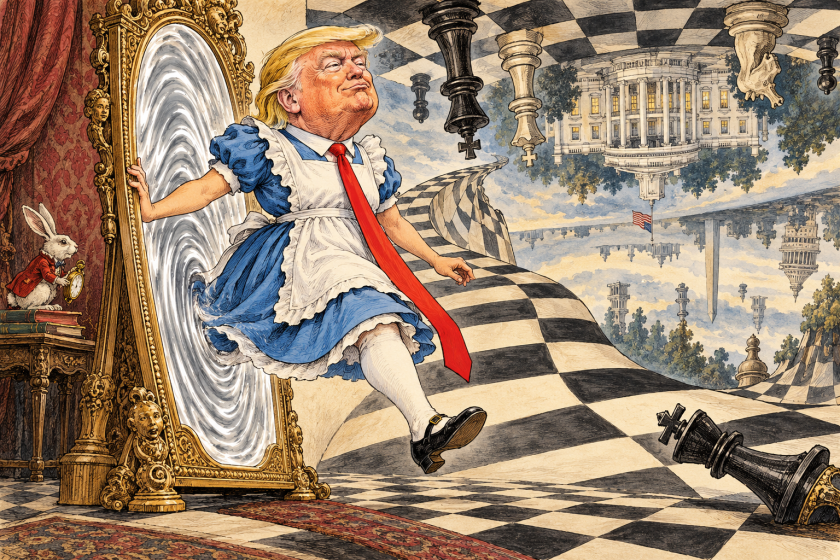
Donald Through the Looking Glass
Donald through the looking glass: where certainty reigns and reality is turned upside down. Illustration: AI-generated political satire.
THE TYRRELL PERSPECTIVE
Strategy, intelligence and the view from Britain
Commentary
Commodore Patrick Tyrrell OBE RN (Ret.)
SAGE International Associate
With apologies to Lewis Carroll
27 October 2026
When Lewis Carroll wrote his sequel to Alice’s Adventures in Wonderland, he created a world in which familiar rules no longer applied. Running as fast as you could might merely keep you in the same place; walking away from your destination could bring you closer. Logic became a trap, and certainty an invitation to confusion.
Looking at the world today, I am increasingly persuaded that we have followed Alice through the looking glass.
The world’s most powerful democracy appears enthralled by a president who treats institutional restraint as a personal affront. Opposition certainly exists. The question is whether it can translate protest into effective protection of the democratic system.
In the West, we have become complacent about democracy, as though its survival were automatic. It gives ordinary people a voice, protects individual freedoms and makes government answerable to those it governs. None of these achievements is irreversible.
Autocrats offer a seductive alternative: decisive leadership, national purpose and freedom from the tiresome business of scrutiny. The interests of the many, they insist, must outweigh the freedoms of the few. Curiously, the few who govern seldom surrender any freedoms of their own.
For all its failures and contradictions, American leadership helped underpin an international order in which prosperity, trade and democratic government expanded enormously after 1945. Today, that leadership increasingly appears selfish, mercenary and puerile. The spectacle of an American president flattering authoritarian rulers while berating democratic allies would surely trouble predecessors who understood that American power depended on more than the personal authority of its president.
Democracies are untidy by design. Their checks and balances can be frustrating, but that frustration serves a purpose: it prevents any individual from treating the machinery of government as personal property.
In the United States, the separation of executive, legislative and judicial power is fundamental to the constitutional settlement. Its effectiveness depends, however, on people being willing to defend it—especially when doing so inconveniences their own party.
The distinction between public office and private interest appears similarly negotiable. The December 2026 G20 summit is scheduled for Trump National Doral, the president’s own Florida resort. Even with the White House’s assurance that hosting will be at cost, the choice raises an obvious question: why should a gathering of world leaders become a showcase for the president’s private brand?
Meanwhile, a Reuters investigation estimated that the president and his sons had added at least $2.3 billion to their fortune through their principal cryptocurrency ventures. Commercial success is not, in itself, evidence of wrongdoing. But such enrichment demands scrutiny when the family involved also occupies the centre of political power.
“Conflict of interest” should describe a problem to be resolved, not an inconvenience to be waved away.
Then there is the Nobel Peace Prize. The president has repeatedly advertised his credentials as a peacemaker and his entitlement to recognition. Yet the United States has also become directly involved in war against Iran. In Looking-Glass Land, apparently, the distance between waging war and demanding a peace prize can be crossed without a moment’s embarrassment.
Some of his appointments reinforce the impression that we are watching government through a distorting mirror.
Health Secretary Robert F. Kennedy Jr.’s campaign against established vaccine policy has drawn warnings from medical experts that undermining confidence in vaccination makes outbreaks harder to contain. A health department should leave preventable diseases fewer opportunities, not leave the public less certain about the means of preventing them.
At the Pentagon, Pete Hegseth’s emphasis on physique, grooming and “warrior” identity sometimes seems better suited to casting a Hollywood war film than preparing a force for twenty-first-century conflict. Fitness and discipline matter. So do logistics, technical competence, intelligence, judgement and the ability to adapt. A military can look formidable on parade and still be dangerously unprepared for the war it must fight.
The appointment of Kimberly Guilfoyle—formerly engaged to the president’s eldest son—as ambassador to Greece also invited questions about the relative weight given to diplomatic experience and proximity to the family. Personal connections are hardly new in ambassadorial appointments. That does not make them a convincing substitute for qualifications.
One of Trump’s most extravagant campaign promises was to end the war in Ukraine within 24 hours. Diplomacy, inconveniently, has proved more complicated than the slogan.
Ukraine itself exposes the deeper inversion. Under the 1994 Budapest Memorandum, the United States, Russia and the United Kingdom reaffirmed their commitment to respect Ukraine’s independence, sovereignty and existing borders in connection with its accession to the Nuclear Non-Proliferation Treaty as a non-nuclear-weapon state. These were security assurances, not an automatic commitment to fight in Ukraine’s defence. Nevertheless, Russia’s subsequent aggression made a mockery of its undertaking.
What lesson should other states draw if surrendering nuclear weapons is followed by invasion—and pressure to accept the aggressor’s gains?
Reports of a possible meeting between Trump, Vladimir Putin and Xi Jinping to discuss Ukraine deepen that concern. The Kremlin has acknowledged that the idea was raised, although no agreed meeting or agenda had been established. A discussion of Ukraine’s future without Ukraine would hardly demonstrate respect for the sovereignty supposedly at issue.
The comparison with Yalta is chilling. Whatever the historical differences, the attraction of such an arrangement to powerful men is obvious: smaller countries become matters for negotiation between larger ones. Their citizens are expected to live with the consequences.
There is a name for this. It is the politics of spheres of influence, dressed up as peacemaking.
The domestic questions are no less disturbing. On 6 January 2021, a mob attacked the US Capitol as Congress met to certify the presidential election result. On returning to office in January 2025, Trump issued sweeping pardons, commuted the sentences of fourteen individuals and directed the dismissal of pending cases relating to the attack.
What message does that send about the consequences of political violence committed in a leader’s name?
As the midterm elections approach, the question is not simply who wins. It is whether an adverse result will be accepted, and whether the institutions responsible for enforcing that result will withstand the pressure placed upon them.
Beyond the midterms lies another transfer of power. Will presidential pardons be used to shield family members and associates? Might a successor pardon Trump himself? How much of the precedent established during his presidencies will survive him?
For America’s allies, these are practical questions. Defence planning, intelligence cooperation and diplomatic commitments depend upon confidence that American undertakings will endure beyond the preferences of one occupant of the White House. Once that confidence is damaged, an election alone cannot restore it.
Alice could eventually wake from her bewildering adventure. We have no such luxury.
In our Looking-Glass world, aggression risks becoming entitlement, loyalty passes for competence, and accountability is dismissed as persecution. Might becomes right—and those who question the inversion are accused of failing to understand it.
The danger is not merely that foolish men acquire great power. It is that everyone else becomes accustomed to calling their folly wisdom.
Editorial note: The Tyrrell Perspective presents Patrick Tyrrell’s analysis and opinions. They do not necessarily represent the views of SAGE International.