
Threshold Conditioning in the Indo-Pacific — Winning Without Invading Taiwan
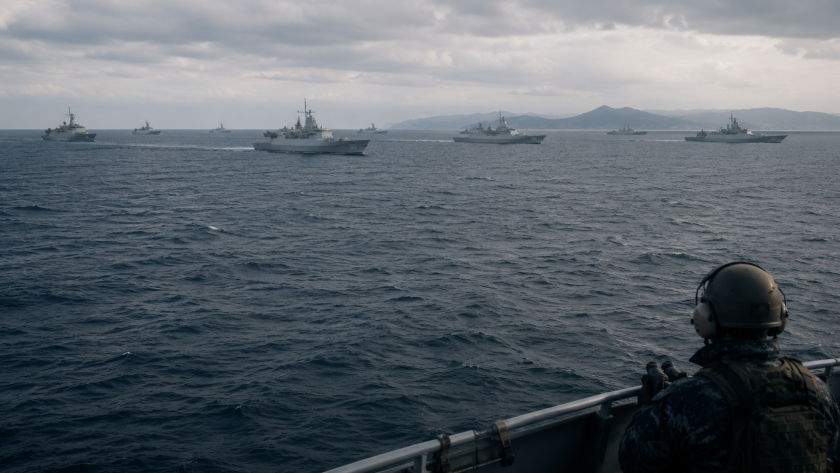
A People’s Liberation Army Navy task group operates in the Indo-Pacific. China’s expanding military reach is increasingly testing regional responses and normalising activities once considered exceptional—an important element of what SAGE defines as “threshold conditioning.” Image: AI-generated conceptual illustration.
SAGE Strategic Intelligence Brief #005
Threshold Conditioning in the Indo-Pacific — Winning Without Invading Taiwan
17 August 2026
SAGE International Australia
Author: Dr John Bruni
Suggested Citation
Bruni, J. (2026). Threshold Conditioning in the Indo-Pacific — Winning Without Invading Taiwan (SAGE International Strategic Intelligence Brief No. 005). Adelaide: SAGE International Australia.
Executive Summary
This brief extends the concept of threshold conditioning developed in SAGE Strategic Intelligence Brief #004 from the Russia–NATO confrontation to the Indo-Pacific.
It assesses that China’s most probable near-term strategy is not a full-scale amphibious invasion of Taiwan, but the progressive alteration of the regional strategic environment through military intimidation, cyber operations, espionage, information warfare, economic coercion and increasingly ambitious military deployments.
A full-scale assault on Taiwan remains possible. However, it would require President Xi Jinping to gamble that the People’s Liberation Army (PLA) can execute one of the most complex joint military operations attempted in the modern era, establish and sustain forces across the Taiwan Strait, overcome Taiwanese resistance, and simultaneously deter or defeat US and potentially allied intervention.
Current depletion of important categories of US precision-guided munitions following the Iran conflict creates a temporary vulnerability which Beijing is almost certainly assessing. However, this opportunity is counterbalanced by China’s own exposure to disrupted energy supplies. High-intensity mechanised and amphibious warfare would place extraordinary demands on petroleum reserves, while maritime trade and energy imports could become vulnerable.
SAGE therefore assesses the probability of a full-scale Chinese amphibious invasion of Taiwan within the next six months at 15–20 per cent (Low Probability).
By contrast, the probability of intensified Chinese activity below the threshold of major war is assessed at 75–85 per cent (High Probability).
The greater immediate danger may consequently be threshold conditioning: China progressively normalising behaviours that previously would have generated greater regional alarm, thereby learning the practical limits of American, Taiwanese, Japanese, Australian and allied tolerance without accepting the potentially catastrophic risks of general war.
Threshold Conditioning in the Indo-Pacific
The previous SAGE Intelligence Brief examined how Russia could weaken NATO without deliberately initiating a conventional war it could not confidently control.
The Indo-Pacific presents a related but structurally different problem.
No regional equivalent of NATO Article 5 exists. Instead, the US-led security architecture consists of bilateral alliances, partnerships, strategic ambiguity surrounding Taiwan, and increasingly important minilateral arrangements.
This creates opportunities for Beijing.
China does not necessarily have to defeat this network militarily.
It may instead attempt to discover when the network acts collectively, when individual states act independently, and when they do not act at all.
The first major Chinese naval deployment near Australia generates considerable attention.
Repeated deployments risk becoming normal.
The first large-scale exercise surrounding Taiwan generates fears that an invasion may be imminent.
Repeated exercises can become part of the regional security environment.
Aircraft incursions, coast-guard confrontations, cyber penetrations, espionage cases, economic coercion and information operations can undergo the same process.
Nothing formal has changed.
But expectations have.
That is threshold conditioning.
Every response also generates intelligence for Beijing.
China observes which activities produce American military deployments, which generate allied statements, which produce economic countermeasures, which divide regional governments, and which disappear from political attention.
Over time, Beijing can progressively map the practical boundaries of Indo-Pacific deterrence.
KEY JUDGEMENTS
- A full-scale Chinese amphibious invasion of Taiwan within the next six months remains unlikely. SAGE assesses its probability at approximately 15–20 per cent. The operation would expose Xi Jinping and the CCP to potentially catastrophic military, economic and political consequences should it fail.
- China does not presently need to invade Taiwan to improve its strategic position. Beijing can obtain strategic advantages through coercion, intimidation, information operations, cyber activity, economic leverage and progressively normalised military activity.
- The depletion of some US missile inventories creates a temporary Chinese opportunity, but not necessarily an invasion window. American vulnerabilities must be weighed against surviving US and allied capabilities and China’s inability to guarantee a rapid, decisive victory.
- PLA command competence remains an important uncertainty. Xi’s continuing military purges demonstrate significant problems involving corruption, discipline and political confidence within senior military structures. They do not establish that the PLA is disloyal, but they raise legitimate questions about command effectiveness under wartime conditions.
- A Chinese opening strike faces a strategic paradox. The attack required to cripple US regional intervention could be so extensive that it guarantees American entry into the war.
- China’s energy exposure complicates any decision to wage a major war. Current disruption to petroleum imports may require Beijing to consume strategic reserves that would otherwise provide resilience during a prolonged military confrontation.
- Threshold conditioning is therefore more attractive than immediate conquest. It lets China impose costs, gather intelligence, establish precedents, and test regional political cohesion while leaving escalation decisions largely to its opponents.
- The principal Indo-Pacific vulnerability is fragmentation. Beijing may seek to discover whether pressure against Taiwan, Japan, the Philippines, Australia or another regional state will be interpreted as an isolated bilateral problem rather than part of a common strategic campaign.
The Taiwan Gamble
The central question surrounding a possible Chinese invasion is frequently framed in terms of capability:
Can the PLA take Taiwan?
A more useful intelligence question is:
Can Xi Jinping be sufficiently confident that the PLA can take Taiwan quickly enough, and at sufficiently acceptable cost, to prevent the conflict becoming strategically disastrous for China?
The distinction is important.
An amphibious invasion across the Taiwan Strait would require an extraordinary integration of missile forces, air power, naval forces, amphibious formations, airborne units, cyber operations, electronic warfare, space capabilities, intelligence, and logistics.
Chinese forces would need to cross a difficult maritime barrier, penetrate prepared Taiwanese defences, secure landing areas, establish logistical flows and sustain mechanised forces ashore.
Meanwhile, Taiwan would not necessarily need to defeat China outright.
It would have to prevent Beijing from achieving its political and military objectives quickly enough for the strategic environment to change.
Delay therefore becomes strategically important.
The longer Taiwan remains capable of organised resistance, the greater the opportunity for American and allied intervention, international mobilisation, sanctions, Chinese economic disruption and domestic uncertainty within the PRC.
A short victorious war could strengthen Xi.
A prolonged unsuccessful war could threaten much more than China’s military prestige.
It could threaten the political credibility of Xi’s leadership.
The PLA Command Problem
This places unusual importance upon the reliability of China’s military command system.
The PLA has undergone extensive modernisation and possesses capabilities that no responsible Western planner should underestimate.
But military capability cannot be measured exclusively through platforms, missiles, ships, and aircraft.
War tests organisations.
The PLA has not fought a major conventional war since China’s 1979 conflict with Vietnam.
Its contemporary command structures, joint operational concepts, long-range strike systems and increasingly sophisticated information architecture have therefore never been tested in a major multidomain conflict against a technologically sophisticated adversary.
Xi’s continuing purges add another uncertainty.
They should not automatically be interpreted as evidence of organised military opposition to Communist Party control.
They do, however, reveal persistent problems involving corruption, discipline, political reliability and leadership confidence.
A Taiwan operation would require commanders to exercise initiative while simultaneously operating within an intensely centralised political system.
The relevant question is therefore not simply whether Xi controls the PLA.
It is whether Xi trusts the PLA to execute an enormously complicated war plan when that plan encounters the inevitable confusion, friction and unexpected reversals of combat.
The First-Strike Paradox
Any Chinese strategy for Taiwan must also address American intervention.
Beijing could attempt to create a military fait accompli before Washington can respond effectively.
This increases the attractiveness of a powerful opening strike.
Taiwanese air bases, command systems, air defences, communications and critical infrastructure could be targeted alongside extensive cyber and electronic operations.
But the issue becomes more difficult once American intervention is considered.
China could attempt to deter Washington from entering the conflict.
Alternatively, it could attack American regional military capabilities at the outset to prevent effective interference.
Both approaches involve risk.
A limited attack may leave sufficient American combat power intact to intervene.
A much larger attack upon US bases, aircraft, ships, communications or other assets could produce precisely the political consequence Beijing wishes to avoid.
This creates a first-strike paradox:
The Chinese attack powerful enough to deter or disable American intervention may simultaneously be the attack most likely to guarantee it.
The Missile–Energy Paradox
The current international environment nevertheless presents Beijing with an unusual strategic calculation.
The Iran conflict has consumed substantial quantities of American precision-guided and defensive munitions.
Beijing will be studying the resulting inventories, replacement rates and defence-industrial capacity carefully.
From one perspective, this creates opportunity.
But the same conflict creates pressure upon China.
China remains heavily dependent upon imported petroleum. Disruption to Middle Eastern energy flows therefore affects Beijing directly.
China possesses substantial strategic and commercial reserves, meaning that temporary disruption does not imply immediate energy exhaustion.
The more important issue is strategic depth.
Every barrel removed from Chinese reserves during peacetime is a barrel unavailable to absorb disruption during a major war.
This becomes particularly important because high-intensity mechanised warfare is extraordinarily fuel-intensive.
Aircraft, warships, amphibious vessels, armoured formations, trucks, generators, and military logistics systems would require enormous quantities of refined petroleum.
A Taiwan war could simultaneously disrupt civilian shipping, international insurance, financial markets and Chinese maritime trade.
The current strategic environment therefore creates a paradox:
The Iran war has weakened part of America’s missile deterrent while simultaneously eroding part of China’s energy cushion.
The resulting balance does not clearly favour immediate Chinese escalation.
Cumulative Deterrence in the Indo-Pacific
If threshold conditioning is the problem, the concept of Cumulative Deterrence developed in SIB #004 also has application in the Indo-Pacific.
The principle remains:
An adversary should not be able to avoid meaningful consequences merely by dividing strategic coercion into sufficiently small individual components.
The institutional challenge, however, is greater than in NATO.
No Indo-Pacific ‘Article 4’ can provide an automatic mechanism for collective consultation.
Nor is there a single alliance encompassing Taiwan, Australia, Japan, the Philippines, South Korea and the United States.
Cumulative deterrence must therefore operate through the network.
Chinese activities against individual countries should increasingly be assessed against the broader regional pattern.
A cyberattack against Taiwan may appear Taiwanese.
Economic coercion against Australia may appear Australian.
Maritime pressure against the Philippines may appear Filipino.
Military activity around Japan may appear Japanese.
A Chinese naval deployment near Australia may appear primarily symbolic.
Viewed separately, each can be compartmentalised.
Viewed together, they may reveal something different: the progressive testing of the US-led Indo-Pacific security system.
Practical Countermeasures
1. Campaign Attribution
Australia, Japan, Taiwan, the Philippines, and the United States should increasingly share assessments of Chinese grey-zone activities as components of a potentially wider campaign.
The relevant question should not simply be:
What did China do to us?
It should also be:
What is China doing across the region?
2. Graduated Networked Consequences
China should not be able to predict that pressure applied against one regional state will generate responses only from that state.
Economic, diplomatic, cyber, intelligence and military responses should increasingly be coordinated among affected partners.
The precise consequences should remain deliberately unpredictable.
3. Resilience as Deterrence
Cybersecurity, energy security, communications redundancy, counter-intelligence, supply-chain resilience and continuity planning should be understood as components of regional deterrence.
China gains less from coercion when targeted states can absorb disruption without political paralysis.
4. Preserve Military Uncertainty
Beijing should not be permitted to calculate with confidence which forms of pressure will or will not produce American or allied military responses.
Excessively explicit Western red lines risk providing China with a map of the territory beneath them.
Strategic ambiguity therefore retains value.
5. Exercise the Network
Regional exercises should test political decision-making as well as military interoperability.
Governments should rehearse ambiguous scenarios involving simultaneous cyber disruption, maritime incidents, information operations and limited Chinese military pressure.
The central question is:
At what point do separate national problems become a collective strategic challenge?
6. Complicate China’s Energy Calculus
Western deterrence planning should recognise China’s continuing dependence upon maritime energy imports.
This does not require threatening an indiscriminate blockade.
Rather, Beijing should understand that initiating major war would expose the Chinese economy to energy, shipping, insurance and supply-chain consequences that cannot be confidently controlled.
Assessment
China’s rapidly expanding military capabilities make a future attempt to seize Taiwan impossible to dismiss.
But capability should not be confused with intent, and opportunity should not be confused with strategic confidence.
A Taiwan invasion would require Xi Jinping to gamble the political credibility of his leadership, the competence of the PLA and a substantial part of China’s economic future on an operation whose outcome cannot be guaranteed.
China possesses another option.
It can continue changing the strategic environment without invading.
Cyber operations can penetrate.
Information operations can divide.
Espionage can acquire.
Economic coercion can intimidate.
Military exercises can exhaust Taiwanese readiness.
Naval deployments can establish new precedents.
Coast-guard and maritime activity can alter facts incrementally.
Each action can remain below the threshold that produces major collective retaliation.
Repeated successfully, these activities can produce threshold conditioning.
The goal need not be immediate Taiwanese surrender.
It may be to create an Indo-Pacific in which Chinese military presence, coercion and political pressure become increasingly accepted as unavoidable features of regional life.
The strategic danger is therefore not simply that China eventually crosses the threshold into war.
It is that Beijing progressively moves the threshold.
Key Policy Recommendations
- Establish mechanisms for cumulative attribution of Chinese coercive activities across the Indo-Pacific rather than treating incidents solely as bilateral events.
- Increase intelligence-sharing among Australia, the United States, Japan, the Philippines, Taiwan, and other relevant partners regarding cyber, maritime, information and military activities.
- Develop graduated collective consequences below the threshold of military conflict.
- Strengthen regional energy, communications, cyber and supply-chain resilience as components of deterrence by denial.
- Exercise political decision-making against ambiguous and simultaneous Chinese coercive activities.
- Maintain sufficient ambiguity concerning the circumstances under which Chinese grey-zone behaviour could produce collective military, economic or diplomatic responses.
- Monitor Chinese petroleum reserves, military fuel movements, civilian shipping mobilisation, and other logistical indicators as potential warning signs of a transition from coercive signalling to war preparation.
These measures are assessed as necessary to prevent repeated Chinese coercive activity from progressively redefining acceptable regional behaviour. (High Confidence)
Confidence Assessment (as of August 2026)
High Confidence
China will continue employing military signalling, cyber operations, espionage, information activity, economic leverage and other coercive instruments below the threshold of major war.
Moderate–High Confidence
Beijing will continue using increasingly ambitious military exercises and deployments to test regional responses, establish precedents and normalise a wider Chinese military presence throughout the Indo-Pacific.
Moderate–High Confidence
A full-scale amphibious invasion of Taiwan is unlikely during the next six months. SAGE presently assesses the probability at approximately 15–20 per cent.
Moderate Confidence
Current depletion of some US missile inventories increases the attractiveness of near-term Chinese coercive activity but is insufficient, by itself, to create a decisive invasion opportunity.
Moderate Confidence
Energy disruption associated with the Iran conflict increases the potential economic and logistical cost to China of initiating a major regional war.
Low Confidence
Beijing presently believes that the PLA can conduct a rapid invasion of Taiwan while simultaneously preventing or defeating substantial US and allied intervention at a politically acceptable cost.
Strategic Outlook: From Threshold Conditioning to Strategic Normalisation
The most important measure of Chinese success may not be territory captured.
It may be behaviour normalised.
A Chinese naval deployment near Australia that once generated alarm may eventually attract little attention.
A major exercise surrounding Taiwan may become routine.
Persistent cyber penetration may come to be regarded as an unavoidable cost of international competition.
Maritime coercion may become another recurring dispute to be managed.
This is how threshold conditioning can become strategic normalisation.
The Indo-Pacific security system therefore faces a challenge different from the one confronting NATO.
NATO must prevent Russia from exploiting ambiguity beneath an established collective-defence threshold.
The Indo-Pacific must prevent China from exploiting the absence of a single threshold altogether.
Beijing’s strategic objective may consequently be less ambitious—and potentially more achievable—than military conquest.
China does not necessarily need to defeat the regional security architecture.
It may only need to demonstrate repeatedly that the architecture cannot decide when it is being challenged.
The strategic contest is therefore partly a contest over normality.
The side that determines what the Indo-Pacific accepts as normal may ultimately shape the regional order without ever having to fight the war both sides have spent decades preparing for.
Disclaimer
SAGE Strategic Intelligence Briefs are produced independently and are intended to support informed discussion of geopolitical, defence, security and economic developments. Assessments reflect information available at the time of publication and may change as new information emerges.
About SAGE International Australia
SAGE International Australia is an independent strategic research and analysis organisation specialising in geopolitics, defence, national security, economic resilience and strategic foresight.
Through objective, evidence-based and non-partisan analysis, SAGE helps decision-makers understand risk, identify opportunity and prepare for future challenges.
For more information, visit: